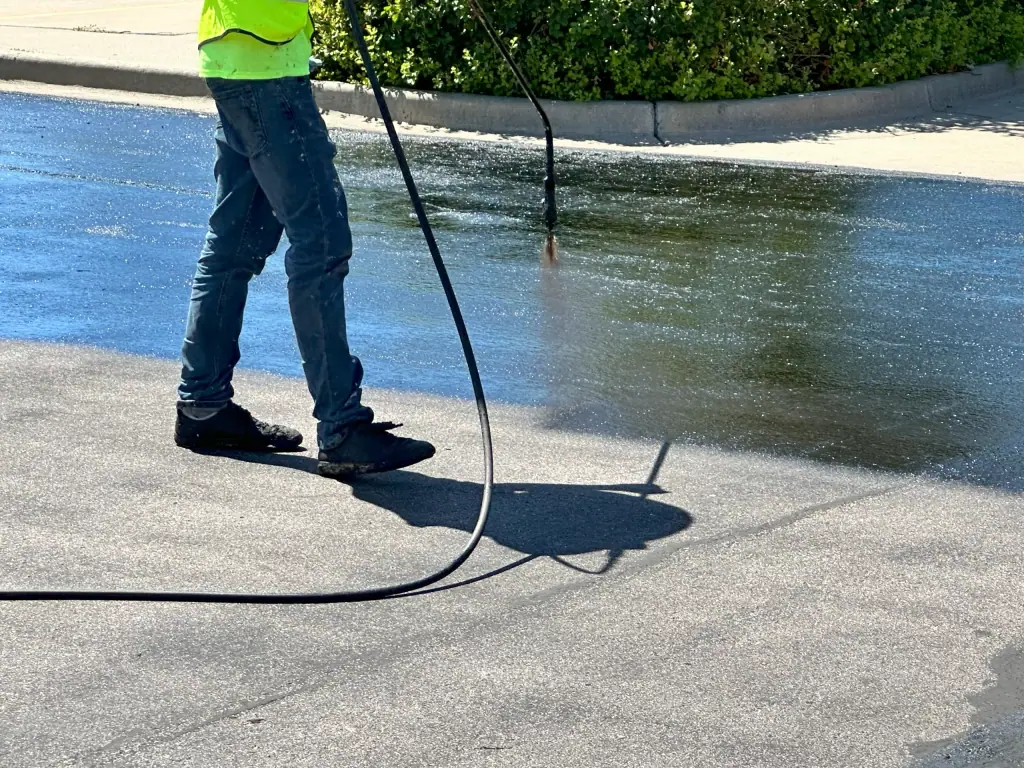
The best time to sealcoat a driveway is during warm, dry weather from late spring through early fall, when both the pavement and air are warm enough for the sealer to cure properly and rain is not expected.
For most asphalt sealers, you want temperatures comfortably above 50°F. Some driveway-sealer manufacturers require 60°F or even 65°F and rising, so the product being applied ultimately determines the minimum temperature.
In Colorado, June through September generally provides the most dependable sealcoating conditions. May can work during a warm stretch, while October becomes much more unpredictable because nighttime temperatures can fall rapidly.
Timing matters because driveway sealer does not simply need to be spread across the pavement. The water or other carrier in the material needs to evaporate so the coating can properly cure and bond to the asphalt.
Warm pavement, dry air, sunshine, and enough rain-free time all help that happen.
When Is the Best Time to Sealcoat a Driveway?
For most homeowners, late spring through early fall is the best time to sealcoat a driveway, with summer and early fall generally offering the most reliable temperatures.
Federal Highway Administration pavement-preservation guidance emphasizes applying maintenance treatments at the correct stage and under appropriate conditions rather than simply performing them according to a fixed calendar. (1)
For homeowners along Colorado’s Front Range, a practical seasonal guide looks like this:
- May: Possible, but watch nighttime temperatures and spring storms.
- June: Excellent once consistently warm weather arrives.
- July: Excellent temperatures, although afternoon thunderstorms can complicate scheduling.
- August: Excellent temperatures, with the same need to watch storms.
- September: Often one of the best months because temperatures remain warm while summer precipitation begins declining.
- October: Sometimes possible, but increasingly risky due to cold nights and early snow.
- November through April: Usually too cold and unpredictable for conventional driveway sealcoating.
NOAA’s 1991–2020 climate normals for nearby Colorado Springs show average highs of 81.6°F in June, 86.5°F in July, 83.6°F in August, and 77.1°F in September. By October, the average nighttime low falls to approximately 36.6°F. (2)
That is why asking whether October is “too late” does not have a simple yes-or-no answer. A warm early-October weather window may work. A late-October day with freezing temperatures expected overnight probably will not.
Expert Insight: FHWA’s Jim Sorenson summarizes proper pavement maintenance as “applying the right treatment to the right road at the right time.” (1)
For Colorado homeowners, the actual forecast matters more than the date printed on the calendar.
Asphalt Sealcoating Temperature Requirements
The minimum temperature for sealcoating depends on the specific sealer, but 50°F should generally be viewed as the lower edge of workable conditions rather than an ideal target.
FHWA guidance for several asphalt pavement-preservation treatments calls for air and pavement temperatures of approximately 50°F and rising. (3)
Residential driveway products may require warmer conditions.
For example, Lowe’s driveway-sealing guidance recommends temperatures of at least 60°F for 24 hours before and after application. Some current Black Jack driveway-sealer specifications require temperatures of at least 65°F and rising during application. (4)
As a practical rule:
60°F to roughly 85°F provides excellent conditions for many driveway sealers, assuming the manufacturer’s instructions agree.
What temperature is too cold to seal a driveway?
Temperatures below 50°F are generally too cold for conventional asphalt sealcoating, and some products should not be applied below 60°F or 65°F.
Cold weather slows evaporation and curing. The surface may look finished while the material underneath remains soft.
Always check:
- Current air temperature
- Pavement temperature
- Overnight low
- Temperature during the following 24 hours
- Manufacturer’s minimum application temperature
Do not assume that one warm afternoon is enough if temperatures are expected to plunge that night.
Can it be too hot to sealcoat?
Yes.
Extremely hot pavement can cause some sealers to dry too quickly, making it difficult to spread the material evenly and maintain a wet edge.
Many products perform best during warm—but not extreme—conditions.
Callout: The goal is not simply “the hottest day possible.” You want steady warmth that allows the coating to cure evenly.
Why Dry Weather and Humidity Control the Curing Process
A driveway should be clean and adequately dry before sealcoat is applied, and rain should not be expected during the curing window.
FHWA pavement-maintenance guidance states that sealing should not proceed when rain is imminent and that moisture should not be present in the surface being treated. (5)
Residential sealer guidance commonly recommends avoiding application when rain is expected for approximately 24 hours before or after the work. (4)
Humidity matters too.
Warm, sunny, low-humidity conditions speed evaporation. Cool, cloudy, humid weather slows it down.
That means two driveways sealed at the same temperature can have very different curing times.
What happens if it rains 24 hours after sealing a driveway?
If the coating has already cured properly, rain after 24 hours may not cause any problem.
If temperatures were cool, humidity was high, the coating was applied too thickly, or the surface has not fully cured, rain can still cause:
- Streaking
- Wash-off
- Uneven coloring
- Soft spots
- Sealer tracking
- Longer curing times
Do not automatically apply another coat if rain hits freshly sealed asphalt. Allow the pavement to dry and inspect the surface first.
Can you sealcoat a driveway if it is wet?
Generally, no.
Standing water, rain-soaked pavement, or moisture trapped in cracks can interfere with adhesion.
Some individual products have specialized surface-preparation instructions, but unless the manufacturer specifically calls for a dampened surface, driveway sealcoating should be performed after the pavement has dried.
Signs Your Driveway Needs Sealcoating
The best time to sealcoat is determined by the condition of the asphalt as well as the weather.
The National Park Service describes pavement preservation as applying appropriate treatments while pavement is still in good condition to reduce water intrusion, oxidation, and further deterioration. (6)
Your driveway may be a good sealcoating candidate when:
- Deep black asphalt has faded toward gray
- The surface looks dry or oxidized
- Minor cracks are beginning to appear
- Previous sealcoat has substantially worn away
- The asphalt remains structurally solid
- There are no widespread potholes or alligator cracks
Sealcoating is preventive maintenance. It works best before major pavement failure begins.
If you are unsure whether the expense makes sense for your pavement, read our guide on whether asphalt sealcoating is worth it.
How often should a driveway be sealcoated?
There is no reason to automatically sealcoat every year.
The Asphalt Institute’s Colorado driveway guidance notes that a high-grade asphalt sealer may be applied approximately every two to five years, depending on conditions. (7)
Actual frequency depends on:
- Sun exposure
- Snow and ice
- Traffic
- Snowplow wear
- Asphalt condition
- Previous coating quality
- Climate
- Sealer used
Inspect the pavement instead of following an arbitrary annual schedule.
FHWA also warns that applying pavement-preservation treatments too early can create problems and spend money before maintenance is actually needed. (1)
How to Prepare Your Driveway Before Sealcoat Application
Good weather will not compensate for poor surface preparation.
FHWA pavement-preservation guidance repeatedly emphasizes surface condition and preparation because coatings need a clean, stable surface to perform properly. (5)
Before sealcoating, the driveway should be inspected for damage and prepared appropriately.
1. Clean the pavement
Remove dirt, sand, leaves, gravel, grass clippings, and other debris.
2. Address oil and chemical contamination
Oil spots may prevent sealer from bonding properly and should be treated according to the coating manufacturer’s recommendations.
3. Repair cracks
Seal or fill appropriate cracks before applying the surface coating.
Sealcoat should not be expected to fill significant cracks on its own.
4. Repair potholes and failed areas
Loose or structurally failed asphalt should be repaired before the driveway is coated.
5. Check the weather
Look beyond the afternoon forecast.
Check rain probability, overnight temperatures, humidity, and the following day’s conditions.
6. Keep vehicles off the driveway
Make arrangements before starting so nobody needs to drive across partially cured sealer.
For homeowners who would rather have the pavement professionally inspected and prepared, Paul’s Asphalt Service provides asphalt sealcoating in Palmer Lake and throughout the Front Range.
How Long Does Driveway Sealer Take to Dry?
Most driveway sealers begin drying within hours, but vehicles should commonly remain off the driveway for approximately 24 to 48 hours.
Lowe’s recommends keeping vehicle traffic off newly sealed asphalt for 24 to 48 hours. Temperature, sunlight, humidity, wind, coating thickness, and the exact product can all change the actual curing time. (4)
A driveway that feels dry when you touch it is not necessarily ready to support a vehicle.
Tires place significant pressure on the coating and can twist against the surface when turning.
Cool nights or humid weather can extend curing considerably.
If your contractor recommends 48 hours, do not drive on it after 24 simply because the surface looks black and dry.
Should you seal a brand-new asphalt driveway?
Not immediately.
The Asphalt Institute states that a well-designed and properly constructed low-traffic driveway or parking lot may not require sealing for approximately two to five years, depending on the climate and quality of the original pavement. (8)
Some consumer sealer manufacturers allow sealcoating sooner—often after six to twelve months.
The important point is that new asphalt should not automatically be sealed simply because it was recently installed.
Allow the pavement to age appropriately and follow the recommendations of the paving contractor and the specific sealer manufacturer.
When Sealcoating Is Not Enough
The best sealcoating weather in the world will not fix pavement that needs structural repair.
FHWA describes pavement preservation as most effective when treatments are applied while pavement is still structurally sound. (9)
Sealcoating may not be the correct treatment if your driveway has:
- Widespread alligator cracking
- Deep potholes
- Significant sinking
- Severe rutting
- Crumbling edges
- Drainage problems
- Base failure
- Large areas of loose asphalt
In those situations, patching, resurfacing, drainage corrections, or repaving may be a better investment.
Expert Insight: FHWA’s Steve Gaj describes pavement preservation as being about “getting more out of your investments.” (10)
That means knowing when not to sealcoat is just as important as choosing the right month.
Frequently Asked Questions About When to Sealcoat a Driveway
FHWA’s preservation research consistently emphasizes that climate, pavement condition, treatment selection, and timing all affect pavement-maintenance performance. (11)
What month should you seal your driveway?
For most climates with cold winters, June through September is the safest general window. Along Colorado’s Front Range, September can be especially favorable because temperatures remain warm while summer thunderstorm activity begins declining.
Is October too late to seal a driveway?
October can be too late in Colorado, particularly when nighttime temperatures approach freezing.
A warm early-October stretch may still work if the sealer’s temperature requirements are met and the forecast remains dry. Late October is considerably riskier.
When should you not seal your driveway?
Do not sealcoat when the pavement is wet, rain is expected during the curing period, temperatures are below the manufacturer’s minimum, freezing weather is approaching, or the asphalt has structural damage that needs repair first.
What temperature is too cold to seal a driveway?
Below 50°F is generally too cold for many traditional sealcoating applications. Some residential products require at least 60°F or 65°F and rising.
Always follow the exact product specification.
What happens if you seal your driveway every year?
Annual sealcoating is usually unnecessary.
It increases maintenance costs and may apply additional material when the previous coating is still performing. Inspect the condition of the asphalt and follow product and contractor recommendations instead.
How many years does sealcoating last?
A practical maintenance interval is often around two to five years, although traffic, climate, sunlight, snow removal, product quality, and application quality can shorten or extend that interval.
What are common mistakes to avoid when sealing a driveway?
Common mistakes include sealing in cold weather, ignoring rain in the forecast, applying sealer to wet or dirty pavement, failing to repair cracks first, coating structurally failing asphalt, applying material too thickly, and allowing vehicle traffic onto the surface before it has cured.
How long should you stay off an asphalt driveway after sealing?
Plan on keeping vehicles off the driveway for approximately 24 to 48 hours, unless the contractor or product manufacturer specifies a longer period.
The Bottom Line
The best time to sealcoat a driveway is during warm, dry weather when the pavement is in good enough condition to benefit from preventive maintenance.
For Colorado homeowners, June through September usually provides the most dependable window.
Do not focus only on the month.
Before the job begins, confirm:
- The pavement is dry
- Air and surface temperatures meet the sealer requirements
- Overnight temperatures will remain warm enough
- Rain is not expected during the curing window
- Cracks and damaged areas have been repaired
- The asphalt is structurally sound
- Vehicles can remain off the surface long enough to cure
If those conditions are met, properly timed sealcoating can help protect your asphalt before minor weathering develops into more expensive deterioration.
Paul’s Asphalt Service LLC provides driveway sealcoating, asphalt repairs, resurfacing, paving, crack repair, and other asphalt paving maintenance services throughout Palmer Lake and surrounding Colorado Front Range communities.
References
- Federal Highway Administration, Pavement Preservation: A Call to Action. https://www.fhwa.dot.gov/publications/focus/03may/03.cfm
- NOAA National Centers for Environmental Information, 1991–2020 Monthly Climate Normals — Colorado Springs. https://www.ncei.noaa.gov/access/services/data/v1?dataset=normals-monthly-1991-2020&endDate=9996-12-31&format=pdf&startDate=0001-01-01&stations=USW00093037
- Federal Highway Administration, Cape Seal Checklist — Weather Requirements. https://www.fhwa.dot.gov/pavement/preservation/2019checklists/hif19043.pdf
- Lowe’s, How to Apply Asphalt Driveway Sealer. https://www.lowes.com/n/how-to/seal-an-asphalt-driveway
- Federal Highway Administration, Crack Seal Application — Weather Requirements. https://www.fhwa.dot.gov/pavement/preservation/ppcl01.pdf
- National Park Service, Pavement Preservation: A Proactive Approach. https://home.nps.gov/subjects/transportation/pavement-preservation.htm
- Asphalt Institute / Colorado Asphalt Pavement Association, Best Practices for the Use of Asphalt Driveways. https://www.asphaltinstitute.org/wp-content/uploads/Best-Practices-for-the-Use-of-Asphalt-Driveways-by-the-Colorado-APA-1.pdf
- Asphalt Institute, Engineering FAQs. https://www.asphaltinstitute.org/engineering/engineering-faqs/
- Federal Highway Administration, The Right Road at the Right Time. https://www.fhwa.dot.gov/publications/focus/00jun/rightroad.cfm
- Federal Highway Administration, Pavement Preservation as a Whole-Life Strategy. https://www.fhwa.dot.gov/innovation/innovator/issue62/mobile/
- Federal Highway Administration, Guidelines for the Preservation of High-Traffic-Volume Roadways. https://www.fhwa.dot.gov/goshrp2/Solutions/All/R26/Guidelines_for_the_Preservation_of_HighTrafficVolume_Roadways
About the Author
Paul Williams
Owner, Paul’s Asphalt Service LLC
Paul Williams is the owner of Paul’s Asphalt Service LLC, a Colorado asphalt paving and maintenance contractor serving residential and commercial properties throughout Palmer Lake and surrounding Front Range communities. Services include asphalt paving, driveway paving, sealcoating, repairs, resurfacing, crack repair, parking lots, and pavement maintenance.
Email: Paul@PaulsAsphaltService.com
Phone: (719) 232-1523
Facebook: https://www.facebook.com/PaulsAsphaltService1
X: https://x.com/PaulsAsphalt
YouTube: https://www.youtube.com/@PaulsAsphaltService