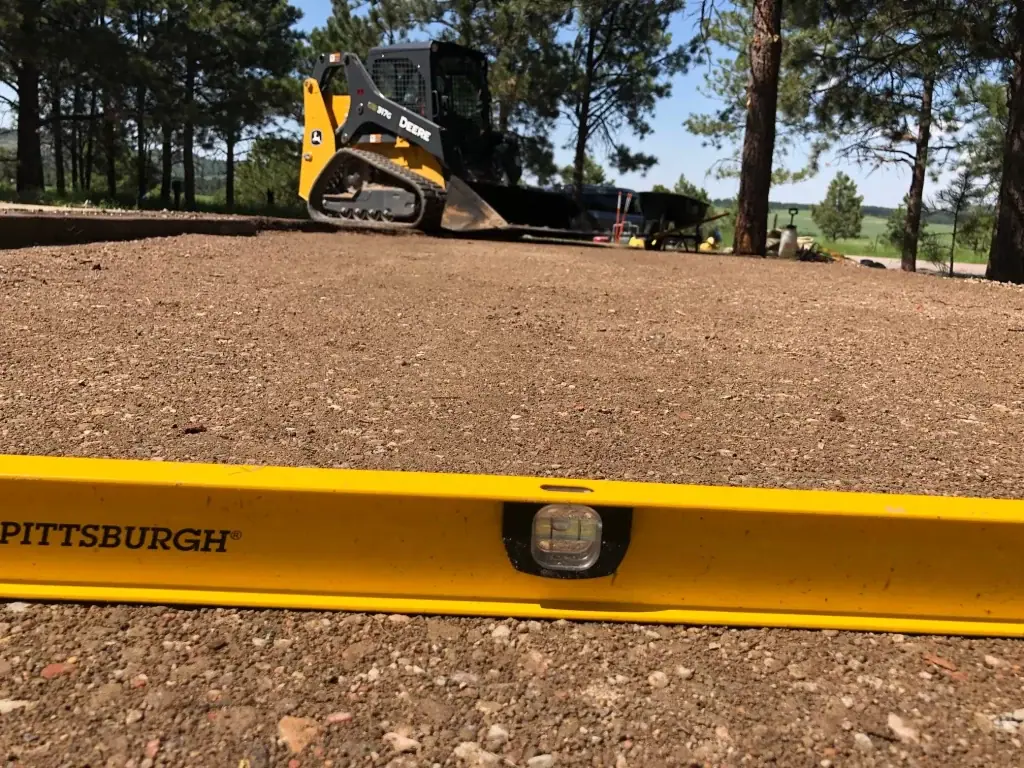
Yes. Hot mix asphalt can be placed on a gravel road in Palmer Lake once the gravel has been graded, drained and compacted into a stable base. Whether the existing gravel can stay, needs more crushed rock, or has to be dug out depends on how soft it is, how much clay it holds, and where the water goes when snow melts.
Palmer Lake sits at 7,139 feet on the Palmer Divide, so the paving season is shorter and freeze and thaw is harder on the ground than at lower elevations. Paul's Asphalt does the base work and the hot mix asphalt paving in Palmer Lake as one job.
Placing Hot Mix Asphalt on an Existing Gravel Road in Palmer Lake
Placing hot mix asphalt on an existing gravel road in Palmer Lake works when the gravel underneath can carry the load and shed water. The strength of the road comes from what lies below the asphalt.
That is where unpaved roads often fall short. A Colorado State University report for the Rocky Mountain Asphalt Paving Conference notes that about 70 percent of Colorado roadways are unpaved, and that roads paved later often had maintenance problems because the foundation and drainage were never improved first.
The same report explains why. A gravel road needs some plasticity in its fines to hold together, and that material "is often an inferior base for a pavement." It can trap moisture and leave a weak layer under the asphalt, leading to early fatigue failure and potholes.
So a gravel road serving a few homes in Palmer Lake, or a long drive on acreage in Black Forest, Peyton or Falcon, can be paved once it is checked and corrected.
When Does Old Gravel Have to Be Reworked or Removed Before Paving?
Old gravel has to be reworked or removed before paving when it moves under load, holds water or has worn down to dirt. Signs to look for:
- Soft spots that pump or flex when a loaded truck rolls over them
- Ruts and potholes that come back after every grading
- Gravel worn so thin that bare soil shows through
- Sticky, clay-heavy material that stays muddy after rain or snowmelt
- Standing water along the edges or across low sections
A drive in Ben Lomand or a shared road in Woodmoor might show one of these in a few spots, which a crew can dig out and rebuild. Several along the length may mean new base across the whole width. Our article on converting a gravel driveway on acreage near Palmer Lake to asphalt covers the driveway side.
How a Crew Prepares a Palmer Lake Gravel Road for Hot Mix
A crew prepares a Palmer Lake gravel road for hot mix by fixing the base and drainage first and paving last:
- Walk the road and probe the gravel for soft spots, thin areas and clay.
- Dig out failed sections down to firm ground.
- Grade the road and shape a crown so water runs off to the sides.
- Clean or cut ditches and set culverts so runoff has somewhere to go.
- Add crushed base where the gravel is thin and blend it into the existing material.
- Compact the base and roll it with heavy equipment to find any spot that still gives.
- Place and roll the hot mix on a dry, unfrozen surface.
The Colorado Department of Transportation's 2023 Division 400 specifications say hot mix asphalt "shall be placed only on properly prepared unfrozen surfaces that are free of water, snow, and ice."
| Condition of the gravel | What the crew does | What it means for the job |
|---|---|---|
| Firm, well drained, no soft spots | Regrade, add a little crushed base, compact | Shortest prep before paving |
| Firm with a few soft or wet areas | Dig out and rebuild those areas | More prep in spots, same plan overall |
| Thin gravel over bare soil | Bring in crushed base to full depth | Base work becomes a larger part of the job |
| Clay-heavy or holding water along the road | Remove poor material, fix ditches and culverts | Drainage work comes before any paving |
A wooded road at the edge of Pike National Forest, which borders the town on the west, or a rural road on the north side near Greenland Open Space Preserve can land in any row.
If your road ruts every spring, or you are unsure which row fits, book a free consultation and let the crew probe the base before anyone prices asphalt alone.
How Thick the Base and Asphalt Should Be on a Palmer Lake Gravel Road
A typical driveway build is a compacted layer of hot mix over a thicker compacted crushed stone base, with more of both for trucks, deliveries or traffic from many homes. The right numbers for any site come from its soil and its use.
For roads that will go into El Paso County maintenance, a licensed geotechnical engineer collects soil samples and, if the road will be paved, provides a pavement thickness design based on the existing soils. The county also requires a paved road when more than 200 daily trips are generated.
The CSU report suggests considering paving as average daily traffic approaches 500 vehicles, and notes that some engineers recommend 22 feet as the minimum safe width for a paved road. A private road serving several homes may be narrower today, so plan for width as well as depth.
How Do Clay and Steep Grades Change the Plan for a Gravel Road?
Clay and steep grades push the plan for a gravel road toward more base work and better drainage. Clay-heavy gravel often has high-plasticity fines that trap moisture under the pavement, which the CSU report links to early potholes. Steep grades send water down the road surface, so the crown and ditches need to carry it off before it cuts the edges.
A hillside lot in Palmer Lake, near Monument Hill at about 7,352 feet, or up toward Larkspur can face both. Paul and his crew handle varying slopes. One customer wrote, "I had a difficult driveway to pave due to varying slope and Paul and his crew did a great job."
Paving a Palmer Lake Driveway Where It Meets a Gravel County Road
A driveway that meets a gravel county road can be paved, but the pavement ends before the driveway culvert. El Paso County's right-of-way FAQ says the driveway surface in the right-of-way should match the road.
Pavement running up to the culvert can be hazardous for the public and maintenance workers in bad weather, and it makes culvert replacement harder. If the county finds a paved driveway in the right-of-way, it can ask the owner to remove it, take enforcement action and charge the removal cost. The owner is also responsible for the driveway culvert and for keeping the ditch maintained 10 feet on each side of it.
These rules cover county roads. Roads owned by the town or an HOA follow their own rules, so check who owns the road your drive meets.
Do You Need an Access Permit for a Driveway That Meets a County Road?
Yes. An Access Permit is required to pave, reconstruct, alter or enlarge any driveway that intersects a county road, and to install, replace or move a driveway culvert. No work on the driveway or culvert in the right-of-way may start before the permit is issued, and applications go through the county's EDARP portal. We plan where the asphalt ends so the new surface stays out of the county right-of-way.
The Paving Season for Gravel Roads at Palmer Lake's Elevation
The paving season at Palmer Lake's elevation runs while the ground is unfrozen and dry and the air is warm enough for the layer being placed. CDOT's state highway spec is a useful guide, though it does not bind a private driveway job. Its Table 401-3 sets these minimum air and surface temperatures for the top layer:
- Under 1.5 inches compacted: 60 F
- 1.5 to under 3 inches: 50 F
- 3 inches or more: 45 F
Layers below the top can go down at 50 F, 40 F and 35 F for the same sizes. Air temperature is read in the shade, the surface reading is taken on the base the asphalt goes onto, and paving stops if either drops below the minimum.
The Palmer Divide is the ridge between the Arkansas and Platte drainages, with Highway 105 running through town and Interstate 25 to the east. By fall the season is winding down here, so finishing base work early leaves room for the warm paving days that remain, and booking ahead lets the crew plan around the forecast.
Why Hire Paul's Asphalt to Pave a Gravel Road in Palmer Lake
Paul's Asphalt suits a gravel road job because one crew handles the base work, the drainage and the paving:
- Base and site work. Gravel base installation, grading and prep, excavation and water drainage.
- Roads of every size. Hot mix paving for driveways, long rural drives, private roads and HOA roads.
- Difficult sites. Varying slopes and long rural driveways are part of the work.
- The owner on the job. Paul works on jobs himself and comes back to fix issues after the job.
- A local record. Ten years serving Palmer Lake and nearby communities from 702 Highway 105, an A+ BBB rating and 4.8 stars on Google.
- An easy start. A free consultation and a phone line that is open 24 hours.
We also work across Monument, Black Forest, and Teller and Douglas Counties.
The Bottom Line
Hot mix asphalt can be placed on a gravel road in Palmer Lake once the gravel becomes a sound base: soft spots dug out, crushed base added, the road crowned and drained, and everything compacted. Driveways that meet a gravel county road stop before the culvert and need an Access Permit, and paving waits for dry, unfrozen ground. For the base work and hot mix asphalt paving in Palmer Lake, call Paul's Asphalt at (719) 232-1523 to book a free consultation.
Providing Asphalt Contractor Services to Palmer Lake and the Greater Colorado Springs Area
Request a Quote