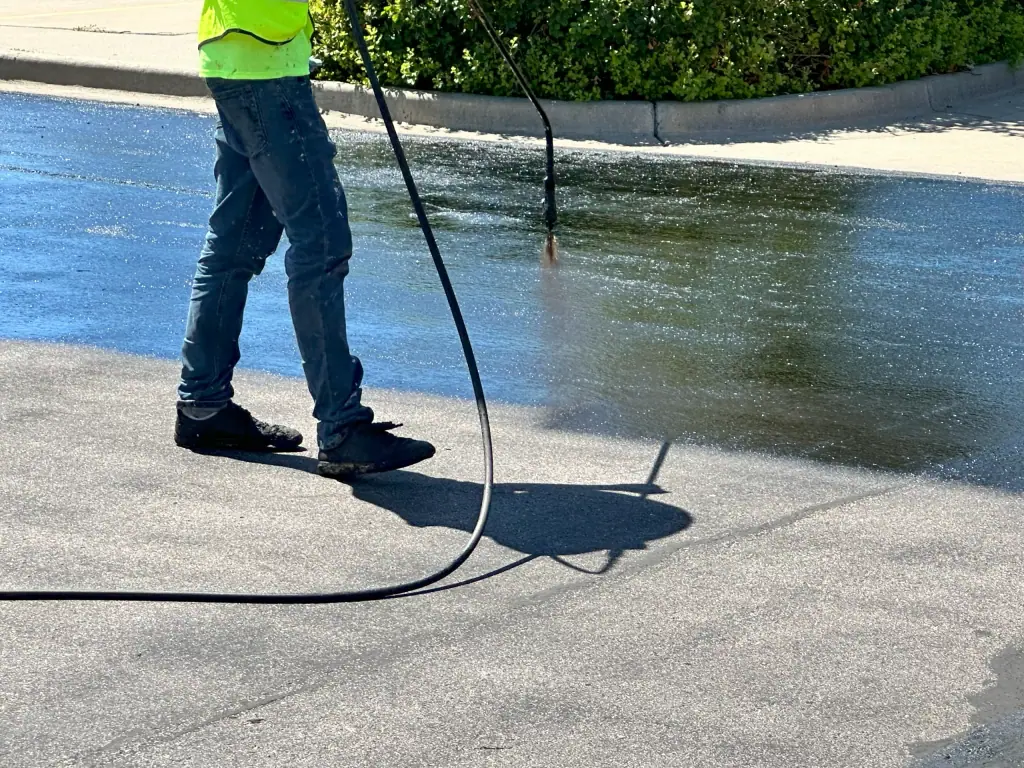
Yes, new asphalt can be tied into your existing parking lot without a seam failing, as long as the old edge is cut back to sound pavement, cleaned, tacked and compacted against, and the base and drainage under both sections match.
That joint is where an asphalt parking lot expansion holds or fails. It matters as much on a storefront lot along Highway 105 as on an HOA lot, and it is a big part of every addition Paul's Asphalt builds around Palmer Lake and Monument.
Why the Seam Between New and Old Asphalt Fails in Palmer Lake
The seam between new and old asphalt fails in Palmer Lake for the same reason it fails on highways: the joint ends up looser and less bonded than the pavement on either side. The Federal Highway Administration puts it plainly: "Low density, permeability, and lack of adhesion can cause premature cracking and joint failure."
Density is the number to watch. A pavement reference built by a consortium of state DOTs, the FHWA and the University of Washington reports that a well-built joint is about 1 to 2 percent less dense than the rest of the lane. A poor one can be 5 to 10 percent less dense.
A loose joint lets water in, and the climate here makes that worse. Palmer Lake sits at 7,139 feet, and I-25 crosses Monument Hill at 7,352 feet. Water in a weak seam freezes, expands and pushes the two sections further apart each cycle.
Where Should the Seam Sit So Traffic Does Not Break It?
The seam should sit where tires roll across it rather than along it. Keep the old and new asphalt joint out of the main aisle's wheel paths and away from entrances, where turning tires twist the surface.
That may mean moving the cut line so the joint follows a row of stall lines. If your lot serves a campus such as Palmer Ridge High School or Monument Academy, keep the joint clear of any lane where buses and cars turn and queue.
Settle the seam location before any cut line is marked. The free consultation is the right time to raise it.
How New Asphalt Is Tied Into an Existing Parking Lot Without the Seam Failing
New asphalt is tied into an existing parking lot without the seam failing by building the joint in a set order, with every step aimed at density and bond. The steps are the same for new stalls beside a shop on Highway 105 or a larger addition in Gleneagle:
- Call for a utility locate. Colorado 811 says "You must notify Colorado 811 even if you are only excavating a few inches," private property included. Allow at least two business days; the site advises allowing three.
- Cut the old edge back to sound pavement. The outer edge of any paved lane is unconfined when it goes down and compacts less, which is why crews on new work trim 1 to 2 inches off it with a cutting wheel. On an older lot, the cut goes back past any crumbling edge to a vertical face.
- Clean the face and the base beside it so new mix meets solid asphalt, not dust.
- Tack the vertical face. A tack coat on the cold side helps the sections bond. Research cited by the same pavement reference found a rubberized tack applied by hand about 1/8 inch thick "worked very well."
- Place the new mat with a small overlap. About 1 inch gives the roller enough material to compress. Too little leaves high air voids in the joint.
- Roll from the new side. The first vibratory pass runs on the hot mat about 6 inches from the joint.
- Seal the finished joint so surface water cannot follow the line down.
| Joint detail | What it does | Where it fits |
|---|---|---|
| Vertical cut face | Removes the loose edge so new mix meets full-depth pavement | Nearly every tie-in |
| Joint heater | An infrared heater on the paver warms the cold side to about 200 degrees F | Long, straight joints on larger additions |
| Sealed joint | Closes the top of the seam to water | Every finished tie-in |
How Long Should a New Seam Be Watched and Sealed?
A new seam should be watched for the life of the lot, because even a well-built joint is slightly less dense than the pavement around it. Walk it each spring. Look for a hairline opening, loose stone or a wet line that lingers after a storm.
Sealing a small opening early keeps water away from the base. Paul's Asphalt offers crack sealing and ongoing maintenance programs, so the crew that built the joint can keep checking it.
What Has to Match Under the Joint Besides the Asphalt
What has to match under the joint, besides the asphalt, is the base: its depth, its compaction and its grade. If the new section sits on a thinner or softer base than the old lot, the two halves settle at different rates and the seam turns into a hinge.
Before any paving, we excavate the expansion area, install and compact the gravel base, and grade it so the new surface meets the old at the same height and slope. Match the old asphalt thickness too, so the joint is never the thinnest point.
Drainage is the other half. Water should cross a seam and keep moving, never run along it, because a joint in a low line becomes a gutter. That planning matters on an event lot near the Tri-Lakes Center for the Arts, a church lot in Monument or a sloped property in Black Forest.
If the old lot already cracks near the tie-in edge, read why Palmer Lake parking lots crack and fail early before you settle on the scope.
ADA and Permit Questions When Adding Spaces to a Palmer Lake Lot
Adding spaces to a Palmer Lake lot does raise ADA and permit questions, and both are easier to settle before the layout is final. Federal ADA guidance on restriping parking lots says a business that restripes must provide accessible parking under the 2010 ADA Standards, and that added accessible spaces should go on "the most level ground close to the accessible entrance."
The accessible route needs no curbs or stairs, a width of at least 3 feet, a firm, stable, slip-resistant surface and a slope no steeper than 1:12. The access aisle can slope no more than 1:48 in any direction.
That 1:48 limit is a seam issue. An access aisle that straddles a joint between sections built to slightly different grades can miss it. For a public-facing lot, such as one serving the Palmer Lake Branch Library on Lower Glenway or the Bustang park-and-ride in Monument, place the ADA parking spaces first and build the grades around them. We handle ADA compliance and striping in the same job.
On permits, the Pikes Peak Regional Building Department lists "Private sidewalks, driveways, and platforms supported directly upon grade" as exempt work. Parking lots are not on that list, so do not assume an expansion is exempt. Check with the Town of Palmer Lake at Town Hall, 42 Valley Crescent (719-481-2953), and with El Paso County before work starts.
The Best Time to Pave a Lot Addition Near Palmer Lake and Monument
The best time to pave a lot addition near Palmer Lake and Monument is the warm middle of the paving season. Hot mix has to be rolled while it is hot, and the seam is where that is hardest, because the old side of the joint is always cold.
At 7,139 feet in Palmer Lake and 6,982 feet in Monument, cool mornings shorten the working day in spring and fall. Paving season in Palmer Lake winds down as October arrives.
If summer is your busy season, book the consultation in late winter or early spring. That leaves time for the locate, any approvals and the ADA layout.
Can a Lot Be Expanded in Stages So the Business Stays Open?
Often, yes, a lot can be expanded in stages so the business stays open. The new area can be excavated and based while customers park on the old lot, and the tie-in day closes only the strip along the joint.
Every stage line is another joint, so stage lines need the same care as the main seam.
Why Hire Paul's Asphalt for a Parking Lot Tie-In in Palmer Lake
Hiring Paul's Asphalt for a parking lot tie-in in Palmer Lake puts every step that decides the seam with one local crew: excavation, gravel base, grading, drainage, paving, curbs and aprons, striping and ADA layout.
We have served Palmer Lake and nearby communities since 2016 from our office on Highway 105, with an A+ BBB rating and 4.8 stars on Google. Paul works on the jobs himself. Reviewers describe a reply the next day, a great job on a difficult slope, and Paul coming back to fix issues after a job.
Our phone is answered 24 hours a day, consultations are free, and we work across Monument, Gleneagle, Black Forest and Colorado Springs.
- If your old lot is cracked or settling where the new section will meet it, then have us repair that edge first; see whether a Palmer Lake parking lot can be paved over existing asphalt for when an overlay makes sense.
- If the business has to stay open, then ask us about staging the work with the stage lines planned around the seam.
- If you are adding spaces, then plan the ADA layout and striping with us at the same consultation.
- If you want it done before winter, then call us early in the season so the joint is paved in warm weather.
The Bottom Line
New asphalt can be tied into an existing parking lot without the seam failing when the joint is built on purpose. Five things decide it: a clean vertical cut to sound pavement, tack on the cold face, a small overlap rolled to full density from the hot side, a base and drainage plan that match the old lot, and a sealed joint that is checked over the years.
Paul and his crew can walk through all of it with you, from seam location to ADA layout. Call (719) 232-1523 for a free consultation on your parking lot expansion in Palmer Lake.
Providing Asphalt Contractor Services to Palmer Lake and the Greater Colorado Springs Area
Request a Quote