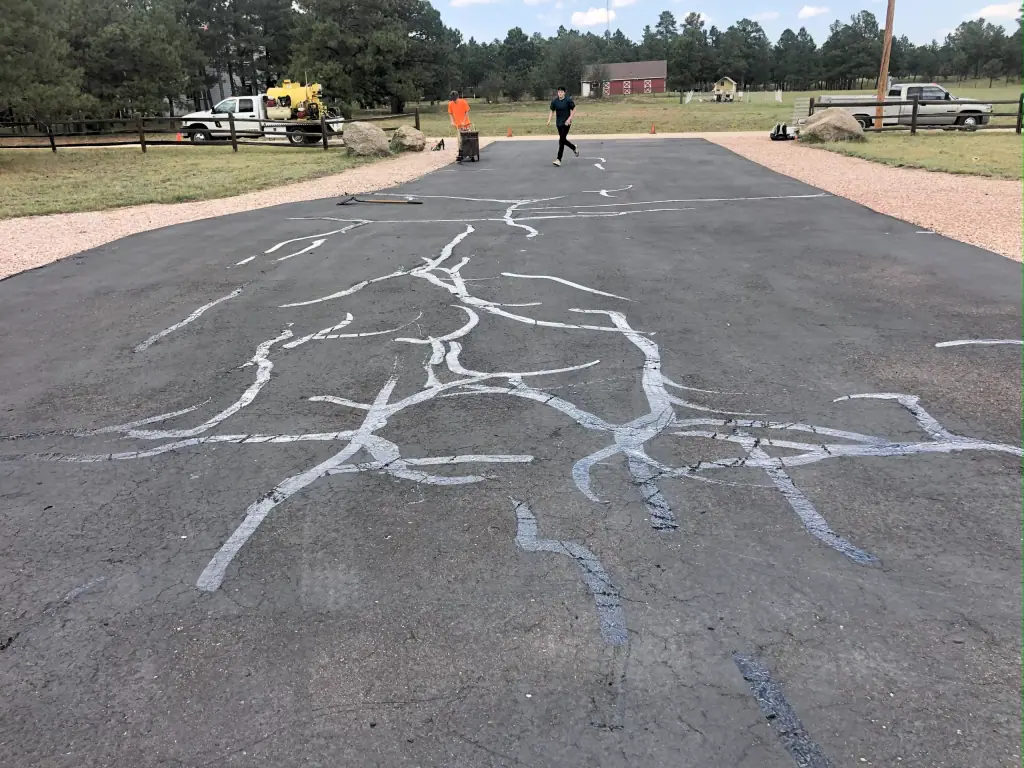
A pothole has usually damaged the base layer under your driveway when the asphalt around it sinks or dips, feels soft or springy underfoot, breaks into a web of alligator cracks, or the hole comes back after it was filled. A shallow hole with firm, flat pavement around it is more often surface damage. The sure check is to open the hole and look for firm, dry support underneath. Paul's Asphalt can look at it during a free consultation for pothole repair in Palmer Lake before a fix is chosen.
Palmer Lake sits at 7,139 feet on the Palmer Divide, and winters get cold enough that the lake itself freezes. That freeze and thaw is how a small hole works down to the gravel below.
Signs a Pothole Has Damaged the Base Layer Under a Palmer Lake Driveway
A pothole has damaged the base layer when the damage shows up beyond the hole itself. Walk the driveway on a dry day and look for these signs:
- The asphalt around the hole sits lower than the rest, or a dip runs along the tire path.
- A spot feels soft or gives a little when you step or drive on it.
- Alligator cracking: connected cracks that break the surface into sharp-angled pieces like chicken wire. The Federal Highway Administration's Distress Identification Manual says this fatigue cracking forms in the wheel paths, where pavement takes repeated traffic loads.
- Fine dirt or sand near cracks, or water seeping up through them. The same manual calls this pumping: water pushed out from beneath the pavement, often leaving fine material behind.
- Edges that keep crumbling, so the hole grows week by week.
- A hole that comes back in the same spot after it was filled.
One sign alone may be minor. Two together, such as a dip with alligator cracking around it, point below the asphalt. Look hardest at the tire paths.
Does Standing Water on a Palmer Lake Driveway Point to a Weak Base?
Standing water on a Palmer Lake driveway does not prove the base is weak, but it is a warning. A puddle that returns to the same low spot after every snowmelt means the surface has settled there or never drained well. If that dip deepens each season, or the water drains into a crack instead of off the edge, the base under it is probably wet.
How Freeze-Thaw at 7,000 Feet Damages the Base Under a Driveway
Water and freeze-thaw damage the base under a Palmer Lake driveway by getting below the asphalt, freezing, and loosening the gravel that holds the surface up. The City of Colorado Springs lists the general causes of potholes as moisture, freeze-thaw action, traffic and poor underlying support. A driveway at 7,139 feet deals with all four.
Water runs into a crack and freezes, pushing the asphalt and gravel apart. When it thaws, it leaves gaps and wet, weak material. Every car then flexes the asphalt over that soft area until it breaks, and the damage moves outward.
Where the water comes from matters as much as the hole. A driveway below a slope, as some are on the west side of town toward Pike National Forest, may take runoff with every melt. Woodmoor sits even higher, at 7,294 feet, with 3,471 housing units in the 2020 census, so many driveways there face the same cycle.
Can an Old Utility Trench or Poor Compaction Cause a Pothole?
An old utility trench or poor compaction can cause a pothole or a sunken strip, because the material in that spot was never as firm as the rest of the base. A trench refilled without solid compaction in layers settles over the years. The typical sign is a straight, narrow dip running from the street toward the house. If it lines up with a water, gas or power line, the repair has to go down into that fill.
Why a Pothole Returns in the Same Spot After a Patch
A pothole returns after a patch because the patch fixed the surface and left the weak base and the water source underneath. New asphalt over wet, loose gravel has nothing firm to sit on. It flexes, cracks at its edges and lets water back in. By the next thaw the hole is open again, often wider.
The table matches what you see to the likely cause and repair. We confirm it on site during the free consultation.
| What you see | What it likely means | Repair that usually fits |
|---|---|---|
| Small, shallow hole with firm, flat pavement around it | Surface damage only | Cut-out patch or infrared repair |
| Hole with alligator cracking around it | Base weakening under the wheel path | Dig-out to firm support, new gravel base, new asphalt |
| Dip, sinking or soft spot near the hole | Base or soil below has lost support | Dig-out, gravel base installation and compaction |
| Water or fine material coming up through cracks | Water trapped under the pavement | Dig-out plus drainage correction |
| Pothole back after a patch | Base and water problem never fixed | Dig-out and drainage work |
| Potholes and cracking across much of the driveway | Widespread base failure | Total removal and replacement |
- If the hole is small and the pavement around it is firm, then have us patch it before winter so it does not grow.
- If you see a dip, a soft spot or alligator cracking, then book a dig-out, because the base is part of the repair.
- If damage covers much of the driveway, then ask about removal and replacement during the free consultation.
What a Dig-Out Repair Involves and When a Driveway Needs One
A Palmer Lake driveway needs a dig-out repair when the material under a pothole can no longer carry weight. The City of Colorado Springs describes dig-outs as the repair for pavement that has failed in localized areas where the underlying support materials have lost their load carrying capacity, requiring removal and replacement of much, if not all, of the base and sub base. The method is also called spot reconstruction.
A dig-out follows these steps:
- Have buried utility lines located and marked.
- Cut the damaged asphalt out past the visible damage, with square edges.
- Remove failed material down to firm, dry support.
- Correct the water source by regrading or adding drainage.
- Place new gravel base and compact it in layers.
- Pave and compact new asphalt, tied into the pavement around it.
Excavation, grading, gravel base installation, water drainage and patching are all services we offer, so we handle the job from the first cut to the new surface.
Does a Palmer Lake Driveway Dig-Out Need Utility Locating First?
Yes, a Palmer Lake driveway dig-out needs utility locating first. Colorado 811's page for professional excavators says state law requires a locate request before any excavation begins, even if you are only excavating a few inches. Allow several business days for the marking.
Patch, Resurface or Replace a Palmer Lake Driveway With a Damaged Base
When the base under a Palmer Lake driveway is damaged, it has to be rebuilt where it failed. A patch or resurface over a soft spot moves with the ground below, so the cracks come back through the new asphalt. The right choice depends on how much of the driveway is affected:
- One or a few failed spots in a sound driveway: dig out and rebuild those spots.
- Base damage in a few places plus a worn surface: dig out the failed areas, then resurface.
- Sinking, alligator cracking and potholes over much of the driveway: total removal and replacement with a new gravel base.
We look at both the pavement and the ground before recommending one.
How Fast Does a Pothole Spread Over a Palmer Lake Winter?
A pothole in a Palmer Lake driveway can spread quickly over a winter, because each freeze opens its edges and each car pushes out more broken asphalt. There is no fixed rate; a hole with a soft spot around it grows faster. Have it checked as soon as you see it. Our phone line is open 24 hours and we handle emergency repairs, so there is no reason to wait for spring.
Why Have Paul's Asphalt Check Your Palmer Lake Pothole
Paul's Asphalt does the base work along with the surface repair. With us you get:
- A free consultation to look at the hole and the pavement around it.
- A locally owned company that has served Palmer Lake and nearby communities for 10 years, with Paul working on jobs himself.
- Excavation, grading, gravel base installation and water drainage, along with patching, infrared repair, resurfacing and full removal and replacement.
- A 24-hour phone line and emergency repairs.
- An A+ BBB rating and 4.8 stars on Google, where reviewers describe a reply the next day and a crew that comes back to fix issues after the job.
We work on driveways, parking lots and private and HOA roads in Palmer Lake, Monument, Gleneagle, Black Forest, Colorado Springs and across El Paso County. State Highway 105 is maintained by the Colorado Department of Transportation, and town streets by Palmer Lake Town Hall at 42 Valley Crescent, 719-481-2953. Your driveway, private road or parking lot is where we come in.
The Bottom Line
A pothole has likely damaged the base under your driveway when the pavement around it sinks, feels soft, shows alligator cracking or lets water and fine material up through cracks, or when the hole keeps coming back. A shallow hole in firm pavement is usually surface damage. Either way, the sure answer comes from opening the hole, checking for firm, dry support and fixing the water that caused it. Call Paul's Asphalt at (719) 232-1523, any hour, to book a free consultation.
Providing Asphalt Contractor Services to Palmer Lake and the Greater Colorado Springs Area
Request a Quote