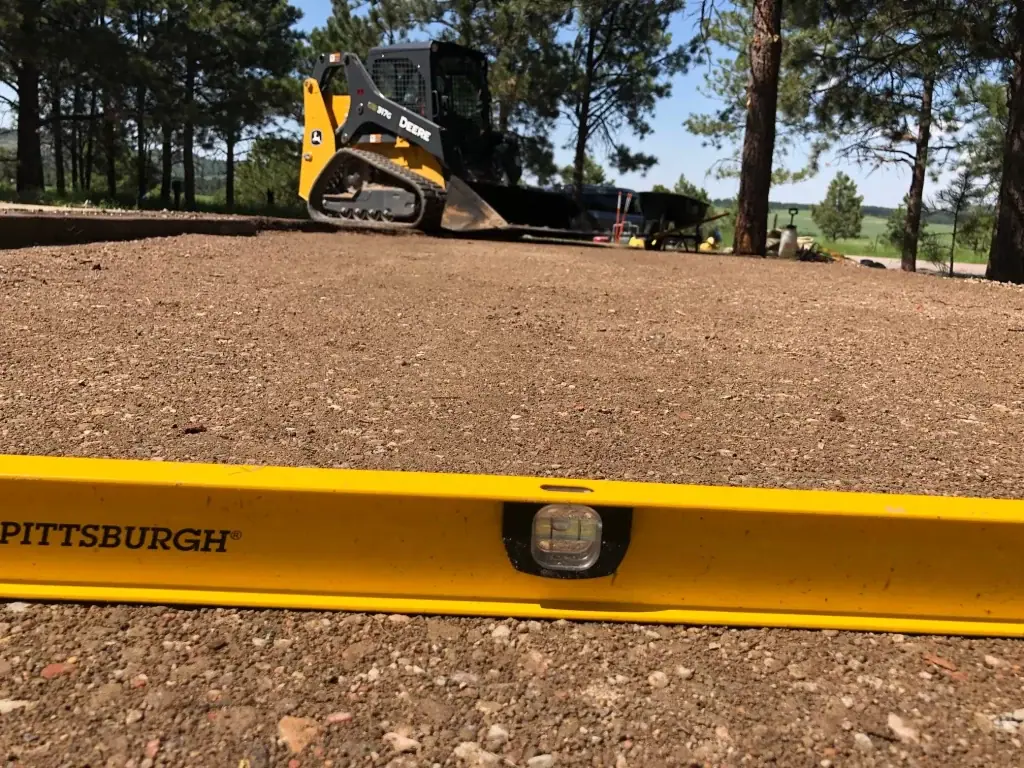
Before hot mix asphalt is placed, Palmer Lake soil needs its topsoil, roots and vegetation stripped, soft spots dug out and replaced, the subgrade shaped to drain and compacted, and a crushed aggregate base compacted in lifts. That buried work decides how long a hot mix asphalt paving job in Palmer Lake lasts. Nobody can inspect it once the mat is rolled.
How much work your lot needs depends on what is under it. The town sits at 7,139 feet on the Palmer Divide, and swelling clay is a known hazard across Colorado. Below we cover the local ground, the steps in order, base depth and the weather limits.
What Is Under the Ground at a Palmer Lake Driveway or Lot
The ground under a Palmer Lake driveway varies across the area, so no single base recipe fits every lot. The Colorado Geological Survey's geologic map of the Palmer Lake quadrangle shows Pikes Peak granite forming the Rampart Range, the sedimentary Dawson Formation as bedrock across the eastern third, and the Rampart Range Fault between them.
That map shows bedrock. The soil on your own property is a separate matter. A wooded lot near the Pike National Forest edge west of town can mean rocky ground plus roots and organic topsoil to clear. Acreage toward Greenland Open Space Preserve or a long drive in Black Forest raises other questions: length, drainage and how the native soil holds up under trucks. Each site gets judged on the ground, by digging into it and watching it under load.
How Do Swelling Clays Damage New Asphalt Around Palmer Lake?
Swelling clays damage new asphalt around Palmer Lake by changing volume under the base as they wet and dry. The Colorado Geological Survey says expansive clay can grow up to 20 percent by volume, that expansion causes nearly all such damage in Colorado, and that cracked and heaved driveways and roads are typical results. It adds that only a competent, professional soil engineer and engineering geologist should be relied upon to identify the hazard.
For a driveway, clay-rich topsoil gets removed or modified instead of paved over, and water is steered away so the soil below stays drier. On a road or large lot with signs of swelling soil, have a soil engineer review the site before the base is designed.
What Base Preparation Steps Palmer Lake Ground Needs Before Hot Mix Asphalt
The base preparation steps Palmer Lake ground needs before hot mix asphalt run in a set order, and each one is checked before the next starts:
- Call 811 for utility locates before digging.
- Clear debris and vegetation, then strip topsoil, roots and clay-rich soil.
- Excavate to the depth the base and asphalt need.
- Shape the subgrade so water does not pond, which matters on a sloped drive near Monument Hill or a lot opening onto Highway 105.
- Recondition and compact the top of the subgrade, adding water to reach density.
- Proof roll and dig out soft spots.
- Place crushed aggregate base in lifts, compacting each one.
- Check the base with a 10 foot straightedge: no more than 1/2 inch of variation.
- Place and roll the hot mix.
Step 5 follows the CDOT Division 300 specifications, which recondition the top 6 inches of subgrade by blading and rolling. Those are state highway rules and do not govern a Palmer Lake driveway. They still set a clear quality bar, and the same checks suit a school parking lot in the Monument area.
Paving straight onto native soil only works when the subgrade is firm, drains well and is shaped to tight limits. CDOT allows asphalt laid directly on subgrade to vary by no more than 0.04 foot. Most lots with topsoil, roots or clay need stripping and a compacted base first.
Where an apron meets a town street, the Town of Palmer Lake office at 42 Valley Crescent, (719) 481-2953, is the contact for questions about work at the street edge.
How Does a Crew Find Soft Spots in Palmer Lake Subgrade?
A crew finds soft spots in Palmer Lake subgrade by proof rolling: driving a loaded dump truck slowly over the shaped ground and watching for movement. The Asphalt Pavement Alliance checklist asks that soil hold its shape under loaded trucks, and says a wet site should wait until it can be proof rolled.
In its lime-treated subgrade section, the state highway standard is to over-excavate soft or unsuitable material found by proof rolling and replace it to a compacted, stable state. For poor clay, CDOT also covers mixing lime into the subgrade, compacting it to at least 95 percent of maximum density and curing it at least 7 days. That treatment is a soils engineer's call for the specific site.
Where ground stays wet or marshy, one building guide recommends fabric between the subgrade and the base stone. Removing soft material and fixing drainage come first. Whether fabric goes in depends on how the subgrade responds.
How Much Compacted Base Belongs Under Hot Mix in Palmer Lake
The compacted base under hot mix in Palmer Lake has no single correct depth. Published guides range from 3 to 8 inches for driveways, with more under heavy trucks. A state asphalt association notes some builders use 6 to 8 inches of compacted aggregate under 3 inches of asphalt. A building guide sets at least 6 inches for cars and pickups and 8 for larger trucks, in angular crushed stone extending about 6 inches past the blacktop. A paving magazine puts typical base courses at 3 to 4 inches.
Traffic, soil and drainage set the number for your site. Whatever the depth, the state highway standard compacts the base in layers no thicker than 6 inches, to at least 95 percent of maximum density with moisture within 2 percent of optimum.
| Situation | What drives the base work | How we handle it |
|---|---|---|
| Car and pickup driveway, firm ground | Stripping and subgrade compaction | Strip, compact, base in lifts |
| Heavy trucks or a private road | Heavier loads | Deeper base, more lifts, proof roll |
| Clay pockets or wet ground | Soil that swells or pumps | Replace soft spots, grade water away |
| Sloped mountain driveway | Runoff on a grade | Grading and drainage before base |
| Long rural driveway | Length and drainage | Excavation, base and paving as one job |
- If you have a standard driveway in Gleneagle or Monument, then book a free consultation with Paul's Asphalt to confirm firm ground and set the depth.
- If trucks use a long drive in Black Forest or Larkspur, then have us plan a deeper base and proof roll it before paving.
- If your lot sits on a hillside near Monument Hill or in Chaparral Hills, then have us do the grading and drainage in the same job as the base.
- If water stands on a wooded lot near Monument after storms, then have us dig out soft spots and fix drainage before any stone goes down.
When Palmer Lake Ground Is Too Cold or Too Wet for Base Work and Paving
Palmer Lake ground is too wet for base work when it cannot be proof rolled. It is too cold for paving when the air is below 40 F, the minimum in the Asphalt Pavement Alliance checklist. CDOT bars lime treatment when lime or soil is below 35 F, when soil is frozen, or while it rains.
Right before paving, the base is checked again for adequate compaction with no visible water or movement. Hot mix can go down as soon as the base passes those checks and holds within 1/2 inch over 10 feet. If rain soaks the base or traffic disturbs it, it gets rechecked and recompacted first.
The Palmer Lake paving season winds down in fall. Call early if you want base and hot mix done before the deep freeze.
Why Hire Paul's Asphalt for Base Preparation and Hot Mix in Palmer Lake
Hiring Paul's Asphalt for base preparation and hot mix in Palmer Lake keeps the buried work and the surface with one company. Grading and prep, excavation, gravel base installation, water drainage and hot mix paving are all services we offer, so one team answers for the base and the asphalt on top of it.
Paul works on jobs himself. One reviewer wrote that Paul replied the very next day and the crew paved the following day. Another, with a driveway of varying slope, said Paul and his crew did a great job. We also come back to fix issues after a job.
We are locally owned at 702 Highway 105 and have served Palmer Lake and nearby communities for 10 years, with an A+ BBB rating and 4.8 stars on Google. Consultations are free, and the phone line is open 24 hours. Sloped drives and long rural driveways are work we take on.
The Bottom Line
Palmer Lake soil needs real preparation before hot mix asphalt goes down. Strip organics and clay topsoil, dig out soft spots, shape and compact the subgrade to drain, then build a crushed stone base in compacted lifts and check it before paving. Depth and any soil treatment depend on your ground and traffic, judged on site. Paul and his crew handle every step, and fall is the time to book if you want the work finished before the deep freeze. Call Paul's Asphalt at (719) 232-1523 for a free consultation.
Providing Asphalt Contractor Services to Palmer Lake and the Greater Colorado Springs Area
Request a Quote