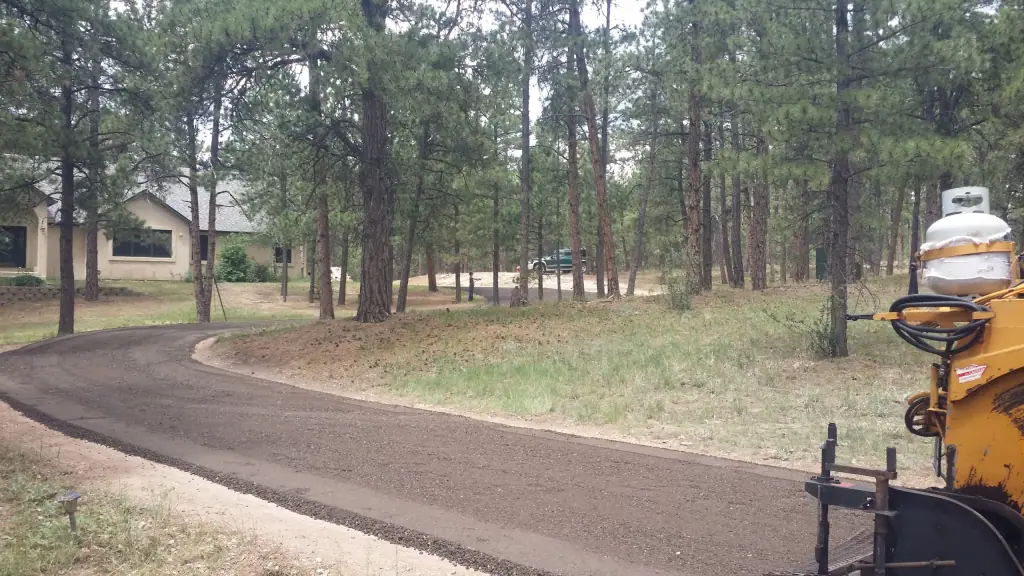
Asphalt costs less to install than concrete in most cases, including in Palmer Lake, CO. Material costs shift with oil markets and cement supply chains, so get a local written quote for current pricing. On a standard residential driveway the savings are real and consistent. Concrete may last longer without resurfacing, but its higher day-one price makes asphalt the lower-cost choice for most Colorado homeowners. Local conditions push that advantage further, because asphalt stays more flexible through freeze-thaw cycles and costs less to repair after frost damage.
What Is the Average Cost Difference Between Asphalt and Concrete Driveways?
Asphalt driveways cost less than concrete driveways to install in most U.S. markets, including Colorado. That price gap is consistent across the Tri-Lakes area (Palmer Lake, Monument, and Woodmoor). Get a local written quote for current pricing, as material costs shift with oil markets and cement supply chains.
Material prices shift with oil markets and cement supply chains, so get a local quote in 2026 for the most accurate number for your property.
| Factor | Asphalt | Concrete |
|---|---|---|
| Material cost | Lower | Higher |
| Typical labor share | Lower | Higher |
| Cure time before use | Shorter | Longer |
| Typical lifespan | Shorter | Longer |
Why Does Asphalt Cost Less Per Square Foot Than Concrete?
Asphalt uses petroleum byproducts as its binder, which costs less to produce than the portland cement used in concrete — a material difference documented by the Federal Highway Administration's asphalt pavement resources. That raw material difference shows up directly in the price per square foot.
Asphalt mixes are produced at a central plant and arrive at your job site ready to lay, which cuts on-site labor time considerably. Concrete requires wood or metal forms, a longer curing period, and more skilled finishing labor to create smooth surfaces and clean edges. Asphalt layers for residential driveways are laid over a prepared gravel base, while concrete slabs require greater thickness plus control joints cut into the surface. More material, more formwork, more skilled finishing time — concrete is simply a more involved pour from start to finish.
Is a Blacktop (Asphalt) Driveway or a Concrete One Cheaper in Colorado?
In Colorado, blacktop (asphalt) driveways are almost always cheaper to install than concrete driveways. The price advantage holds across the Front Range and mountain-adjacent communities like Palmer Lake.
Colorado's high altitude and dramatic temperature swings affect both materials, but asphalt handles those swings better. Asphalt stays more flexible in cold temperatures, which reduces cracking from ground movement. Concrete becomes brittle and is more likely to crack badly when the ground heaves during Palmer Lake's cold winters. Crack repair on concrete costs more per linear foot than patching asphalt. A concrete crack may require saw-cutting, routing, and injecting epoxy or polyurethane filler, while an asphalt crack can be filled with a hot or cold pour sealant at a fraction of that cost. We see this play out every spring when homeowners call us after a hard winter. Many contractors working in cold-climate, mountain-adjacent areas recommend asphalt for properties where freeze-thaw activity is significant, because of this maintenance cost difference.
How Do Colorado's Freeze-Thaw Cycles Affect Installation Costs?
Freeze-thaw cycles in Palmer Lake and the Tri-Lakes area demand a deeper, better-compacted base, which adds cost to both asphalt and concrete jobs. Water works into the ground, freezes, expands, and pushes upward. A weak base lets that movement destroy the surface above it.
A properly built asphalt driveway in Colorado requires adequate compacted gravel base before any asphalt goes down. Ask your contractor to specify base depth in writing on any quote. Skimping on proper base prep saves money upfront but causes premature cracking and costly repairs within a few years. Both materials require this extra base work in freeze-thaw climates, and asphalt still typically wins on total installed cost even with proper base preparation included in the bid. When comparing quotes, confirm that base depth is specified in writing so you're comparing equal work, not just equal numbers.
What Hidden Costs Should You Know Before Choosing Asphalt or Concrete?
Several costs beyond material and labor can change which driveway type is truly cheaper for your property. These costs apply to both materials but vary by site conditions.
Before you commit to either material, budget for these five items:
-
Grading and excavation. Sloped or rocky lots, which are common around Palmer Lake, can add significant cost depending on how much earth needs moving. Rocky soil requires mechanical breaking before any base gravel goes in. Get this scoped in writing as part of your quote.
-
Permits. Local municipalities may require permits for new driveway construction. Ask your contractor to confirm permit requirements and associated fees before work begins.
-
Drainage corrections. Poor drainage causes early failure in both asphalt and concrete. Adding drains, swales, or regrading adds cost up front but prevents much bigger bills later. A driveway that holds water against the foundation is a liability regardless of the surface material, and honestly, it's a problem we'd rather fix before we pave than after.
-
Seal coating for asphalt. Asphalt needs periodic seal coating to protect the binder from UV degradation and oxidation. The frequency and cost per application vary by market and project size. Get a local quote. Concrete rarely needs sealing but may need joint caulking periodically to prevent water infiltration.
-
Tear-out of an existing driveway. Replacing an old driveway adds demolition and haul-away costs for either material. Concrete demolition is generally more labor-intensive than asphalt demolition because concrete's rigidity makes it harder to break and remove.
Getting an itemized written quote that separates these costs from base material and labor costs helps you compare bids accurately.
How Long Does Each Driveway Type Last in the Palmer Lake Climate?
Asphalt driveways can last for many years with proper maintenance. Concrete driveways typically last longer, but cost more upfront and are harder to repair when something goes wrong.
A longer lifespan doesn't always mean a lower total cost. The upfront savings on asphalt can offset a shorter service life, especially if you maintain the surface correctly. Regular seal coating extends asphalt life in Colorado's UV-intense, high-altitude environment where sun exposure accelerates surface oxidation. Concrete resists UV degradation better than asphalt, but it suffers from chloride-based deicers that many Colorado homeowners use in winter. Those deicers cause surface scaling, where the top layer of concrete flakes away, shortening the usable life of the slab and raising repair costs. We see a lot of scaled concrete driveways in this area, and the culprit is almost always the bag of rock salt in the garage.
For homeowners who plan to stay in their Palmer Lake home for a shorter period, asphalt's lower install cost often makes more financial sense. For homeowners planning a long stay on stable, well-drained soil, concrete may eventually pay off.
Does Asphalt or Concrete Need More Maintenance in Colorado?
Asphalt needs more routine maintenance than concrete, but each individual maintenance task is relatively inexpensive and straightforward to schedule. The key is not skipping those tasks.
For asphalt: seal coat periodically, fill cracks as they appear before water gets in and widens them, and avoid parking heavy equipment in the same spot on hot summer days when the surface can soften under concentrated loads. For concrete: seal the expansion joints periodically, avoid chloride-based deicers entirely, and repair spalling quickly when it appears. Spalling left untreated spreads rapidly through freeze-thaw cycles.
Both materials need attention after hard winters. Asphalt patch repairs typically cost less per visit. Neglecting either surface speeds up deterioration and raises the cost of eventual replacement.
When Does Concrete Actually Cost Less Over Time Than Asphalt?
Concrete can cost less over a longer period if you factor in fewer resurfacings and lower long-term maintenance frequency. We've seen it happen, but it comes with conditions that most Palmer Lake lots don't meet.
This long-term savings only applies when concrete is installed on a stable, well-drained base free from heavy frost heave. Properties with expansive soils or heavy clay content carry higher risk for concrete cracking, and once a concrete slab cracks through, repair costs climb quickly. Commercial properties with heavy truck traffic sometimes find concrete more cost-effective because it handles heavy axle loads better without rutting, but residential driveways in Palmer Lake rarely face that kind of load.
For most Palmer Lake residential driveways, reaching a long-term break-even point where concrete becomes cheaper over time requires a proper installation on good soil and avoiding deicer use throughout the driveway's life. Most homeowners can't guarantee both of those conditions. That's not us steering you toward asphalt — that's just the reality of what we see on these lots.
What Questions Should You Ask an Asphalt Contractor Before Getting a Quote?
Ask about base depth, mix thickness, drainage plan, and whether the quote includes all prep work before accepting any bid. A low bid that skips base preparation is not a good deal.
Before you sign anything, get answers to these five questions in writing:
-
How thick will the asphalt be? Ask for this number in writing on your quote and confirm it meets the minimum for a residential driveway in your climate.
-
What base preparation is included? Ask how many inches of compacted gravel base are included. Skimping on base is a leading cause of early asphalt failure in cold climates.
-
What mix type will you use? A polymer-modified asphalt mix is designed to handle wide temperature swings better than a standard mix. Discuss mix options with your contractor.
-
Are you licensed and insured in Colorado? Confirm the contractor carries general liability insurance and is properly licensed to work in your area. Ask to see proof before work begins.
-
Does the quote include drainage corrections? If your lot has drainage issues, we look for them before we pave. Paving over a drainage problem guarantees early failure.
Get at least two or three written, itemized quotes for any project over 500 square feet. Comparing itemized quotes reveals where contractors differ in scope, not just price.
The Bottom Line
Asphalt costs less to install than concrete in almost every residential scenario in Palmer Lake and the surrounding Tri-Lakes area. Concrete can be the better long-term value on stable soil with a long enough timeline, but those conditions don't apply to most local properties. Colorado's freeze-thaw climate, high UV exposure, and winter deicer use all point most homeowners on a budget toward asphalt as the lower-cost day-one choice. For full details on materials, base prep, and local pricing, see our asphalt driveway installation in Palmer Lake service page.
Ready to price out an asphalt driveway? Paul's Asphalt Service is a local Palmer Lake asphalt contractor offering free on-site estimates. Call (719) 232-1523.