

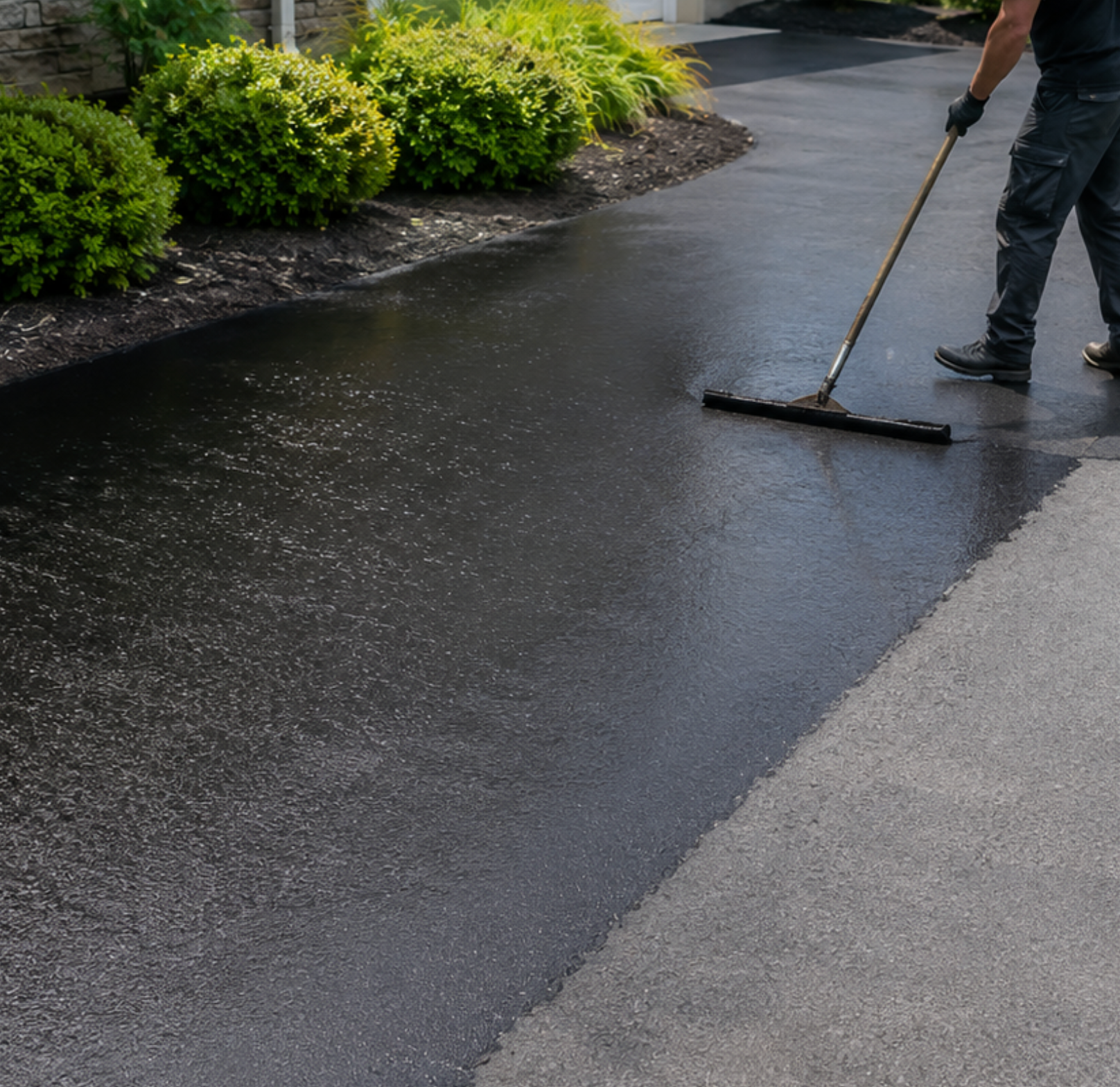
Is asphalt sealcoating worth it? In most cases, yes—but only when the asphalt underneath is still in reasonably good condition. Sealcoating can help protect a structurally sound driveway, parking lot, or other asphalt surface from weathering, water intrusion, oxidation, and everyday wear. It also restores the dark black appearance many property owners want.
What sealcoating cannot do is repair a failing pavement structure.
If your asphalt has widespread alligator cracking, deep potholes, major rutting, drainage problems, or a failing base, putting a black coating over it will not solve those problems. You may get a temporary cosmetic improvement, but the underlying damage will continue.
That distinction is where a lot of the confusion about sealcoating comes from.
Some property owners swear by it. Others say you should “never seal asphalt.” Both opinions usually come from seeing sealcoating used under very different conditions.
Here is how to determine whether sealcoating is actually worth the money for your pavement.
Is Asphalt Sealcoating Worth It? Short Answer
Yes, sealcoating is generally worth it when it is used as preventive maintenance on asphalt that is still structurally sound.
The Federal Highway Administration describes pavement preservation as applying cost-effective treatments to pavement that still has meaningful remaining service life. The purpose is to slow deterioration and postpone more expensive rehabilitation or reconstruction. ([1])
That same principle applies to residential driveways and commercial parking lots.
Sealcoating makes the most sense when the pavement:
- Is still structurally solid
- Has begun fading from black to gray
- Shows surface oxidation or light weathering
- Has only minor cracks that can be repaired first
- Does not have widespread base failure
- Is being maintained before serious deterioration begins
Sealcoating becomes much less valuable when the asphalt already needs major repair.
Expert Insight: “Applying the right treatment to the right road at the right time allows highway agencies to get the most out of their maintenance dollars.” — Jim Sorenson, Federal Highway Administration ([2])
That is probably the simplest way to think about sealcoating as well: right treatment, right pavement, right time.
What Does Asphalt Sealcoating Actually Do?
Sealcoating creates a protective surface layer over existing asphalt. It is primarily a maintenance treatment—not a structural repair.
Seal treatments are used within pavement-preservation programs to reduce deterioration and protect existing pavement. FHWA guidance distinguishes preservation treatments from structural rehabilitation because preservation does not substantially increase the pavement’s load-carrying capacity. ([3])
A good sealcoat can help:
- Reduce exposure of the asphalt binder to sunlight and weather
- Limit surface water penetration
- Slow oxidation and surface deterioration
- Protect against some oil and chemical spills
- Reduce minor surface wear
- Restore a darker, more uniform appearance
It essentially gives the existing pavement another layer of defense against the environment.
This can be especially useful in Colorado, where asphalt is exposed to strong sunlight, snow, moisture, temperature swings, and repeated freezing and thawing.
Paul’s Asphalt Service provides dedicated asphalt sealcoating and maintenance services in Palmer Lake and along the Front Range for driveways, roads, parking lots, and other paved surfaces.
Important: Sealcoat should never be confused with new asphalt. It does not replace damaged material, rebuild the base, or restore structural strength.
Sealing an Asphalt Driveway: Pros and Cons
There are legitimate advantages and disadvantages to sealcoating. Understanding both is much more useful than simply asking whether asphalt should “always” or “never” be sealed.
The FHWA has found that properly selected pavement-preservation treatments can extend the useful life of existing pavement, but effectiveness depends heavily on the pavement condition before treatment. ([4])
Advantages of Asphalt Sealcoating
Slows surface deterioration
As asphalt ages, the binder gradually oxidizes and the surface often becomes lighter, drier, and more brittle. Sealcoating provides a sacrificial protective layer over that surface.
Helps reduce water intrusion
Water is one of asphalt’s biggest enemies once cracks begin developing. Keeping moisture from penetrating into weak areas helps reduce the conditions that contribute to additional deterioration.
Improves curb appeal
Fresh sealcoat turns faded gray pavement back to a deep black finish. For homeowners, HOAs, apartment complexes, retail properties, and commercial facilities, the visual improvement can be substantial.
Makes maintenance easier to plan
Preventive maintenance allows property owners to address deterioration while problems are still relatively small instead of waiting for complete pavement failure.
Can postpone more expensive work
Sealcoating will not eliminate the eventual need for resurfacing or replacement, but appropriate maintenance can help keep sound pavement serviceable longer.
Disadvantages of Sealcoating
It costs money and must eventually be repeated
Sealcoat wears away. It is not a permanent application.
Poor preparation can cause premature failure
Applying sealer over dirt, loose material, untreated cracks, oil contamination, or failing pavement can produce disappointing results.
The pavement cannot immediately be used
The coating needs adequate time to dry and cure before vehicles return to the surface.
It can hide problems without fixing them
Fresh black sealer can make deteriorated asphalt look dramatically better even though structural cracks remain underneath.
Some sealcoat materials raise environmental concerns
The U.S. Geological Survey has extensively documented concerns surrounding coal-tar-based pavement sealers, which contain much higher concentrations of polycyclic aromatic hydrocarbons than asphalt-based sealcoating products. ([5])
For that reason, property owners should ask their contractor what type of sealant is being applied rather than treating every black pavement coating as the same product.
Contractor Callout: If someone recommends sealcoating without first looking at cracks, drainage, potholes, base movement, and overall pavement condition, you are not really getting a pavement assessment—you are getting a sealcoating sales pitch.
When Is Sealcoating Worth the Money?
Sealcoating provides the most value when it is applied before the asphalt reaches the point where surface maintenance can no longer solve the problem.
FHWA preservation guidance repeatedly emphasizes treating pavement while it is still in good condition instead of waiting until major structural deterioration has occurred. ([1])
Perfect Candidates for Sealcoating
Sealcoating is usually worth considering when your pavement has:
- A faded gray appearance
- Light surface oxidation
- Minor weathering
- Small isolated cracks that can be sealed first
- A solid base
- No major potholes
- No widespread alligator cracking
- No serious drainage or sinking problems
You may also choose to sealcoat primarily for appearance.
For example, a commercial property owner may want to refresh a faded parking lot before leasing a building, selling a property, restriping the lot, or improving the appearance customers see when they arrive.
Those are legitimate reasons to sealcoat—as long as everyone understands that the purpose is partly cosmetic.
Professional asphalt paving maintenance services can also combine sealcoating with crack repair, patching, resurfacing, and other treatments instead of relying on one maintenance method for every pavement problem.
When Is Sealcoating Not Worth It?
Sealcoating is usually not the right investment when the pavement has already moved beyond surface deterioration into structural failure.
Washington State transportation research notes that surface seal treatments do not increase structural pavement capacity and become ineffective once structural deterioration has already occurred. ([6])
Terrible Candidates for Sealcoating
Be cautious about sealcoating pavement with:
- Widespread alligator cracking
- Large or recurring potholes
- Severe rutting
- Crumbling asphalt
- Large sunken areas
- Base failure
- Significant drainage problems
- Large sections that move or flex under vehicles
These problems normally require some combination of patching, base repair, milling, resurfacing, or complete removal and replacement.
Putting sealer over severe alligator cracking is similar to painting over rotted wood. It may temporarily improve the appearance, but the deterioration underneath is still there.
This is one reason some people conclude that driveway sealing is “pointless.”
The real problem may not have been the sealcoat itself. The wrong treatment was applied to pavement that had already deteriorated too far.
If your pavement has reached that stage, evaluate professional asphalt paving and repair options in Palmer Lake before spending money repeatedly coating a failing surface.
Sealcoating vs. Crack Sealing vs. Resurfacing vs. Repaving
Sealcoating is only one tool in asphalt maintenance.
FHWA pavement-preservation guidance separates preventive surface treatments from structural rehabilitation because each solves a different type of problem. ([7])
Sealcoating
Best for: Surface protection, oxidation, fading, light weathering and appearance.
It adds a protective coating over existing pavement.
Crack Sealing
Best for: Individual cracks that are allowing water into the pavement.
Cracks should generally be treated before applying sealcoat rather than simply painting sealer across them.
Asphalt Patching
Best for: Localized potholes or failed sections.
Damaged asphalt is removed or repaired before broader maintenance takes place.
Asphalt Resurfacing
Best for: Widespread surface deterioration when the underlying pavement and base can still support an overlay.
A new layer of asphalt is installed over the existing pavement.
Complete Repaving
Best for: Severe deterioration, extensive base failure, drainage problems, or pavement that has reached the end of its useful life.
The important point is that sealcoating does not compete with these treatments.
They solve different problems.
Expert Insight: FHWA’s Steve Gaj describes pavement preservation as “getting more out of your investments.” ([8])
Sometimes that means applying sealcoat.
Other times the smartest investment is repairing the pavement first.
How Often Should Asphalt Be Sealcoated?
There is no single schedule that applies to every driveway or parking lot.
Traffic, sunlight, snow removal, climate, material, pavement condition, application quality, and previous maintenance all influence how quickly the protective surface wears.
Minnesota Department of Transportation guidance for certain asphalt surface and rejuvenator seals notes reapplication intervals around four to six years depending on the product and roadway. ([9]) Residential and commercial driveway sealcoat products are often maintained on somewhat shorter cycles.
A common practical range is approximately every two to four years, but condition should matter more than the calendar.
You probably do not need to reseal pavement simply because a certain number of years have passed.
Look at the surface.
If the previous coating still has substantial coverage and the asphalt remains well protected, applying another heavy layer prematurely may provide little additional value.
If the pavement is faded, exposed, or showing early deterioration, it may be time for another application.
Callout: Sealcoating should be part of a maintenance plan—not an automatic subscription performed every year whether the asphalt needs it or not.
What Is the Best Time of Year to Seal an Asphalt Driveway?
Warm, dry weather generally provides the best conditions for asphalt sealcoating.
State transportation specifications for pavement seal treatments commonly require warm pavement and air temperatures and prohibit installation during unsuitable rain or wet-weather conditions. Minnesota’s pavement-preservation guidance, for example, specifies warm-weather placement and temperature requirements for seal-coat work. ([9])
For Colorado property owners, the practical sealcoating season is usually late spring through early fall, depending on elevation and current weather.
The exact month matters less than the conditions.
You want:
- Warm pavement
- Mild overnight temperatures
- Dry weather
- No immediate rain expected
- Enough curing time before vehicles return
- Conditions that meet the sealant manufacturer’s specifications
Is October Too Late to Seal a Driveway?
Sometimes.
A warm, dry October period may still provide workable conditions in parts of Colorado, while cold nights at higher elevations can make October a poor choice.
Do not choose the application date simply because the calendar says it is still fall. Look at the actual daytime temperature, overnight temperature, pavement temperature, rain forecast, and product requirements.
Common Mistakes to Avoid When Sealcoating Asphalt
Even good pavement-preservation materials perform poorly when applied at the wrong time or to the wrong surface. FHWA specifically warns that preservation treatments applied too late can produce poor performance. ([2])
Some of the most common sealcoating mistakes include:
Sealcoating Over Major Damage
Sealcoat cannot hold together asphalt that is already breaking apart.
Not Repairing Cracks First
Open cracks can continue allowing water below the surface even though everything around them has been freshly coated.
Ignoring Drainage Problems
If water regularly pools, flows underneath the pavement, or erodes the base, coating the top does not fix the cause.
Applying Too Much Sealer
More material is not automatically better. Excessively thick applications may cure poorly and wear unevenly.
Sealing New Asphalt Too Soon
Brand-new asphalt should not automatically be coated immediately after installation. Allow the pavement adequate curing time and follow the recommendations for the particular asphalt and sealing system being used.
Applying Sealer in Bad Weather
Cool temperatures, moisture, rain, or insufficient curing conditions can compromise the finished coating.
Choosing a Contractor Based Only on Price
Proper cleaning, crack preparation, material selection, application rate, and curing all matter.
Two contractors offering “sealcoating” may be proposing substantially different work.
Frequently Asked Questions About Asphalt Sealcoating
Pavement-preservation research consistently shows that treatment selection should consider existing pavement condition, climate, traffic, and expected performance rather than relying on a single maintenance treatment everywhere. ([10])
What are the downsides of sealcoating a driveway?
The main downsides are the upfront cost, recurring maintenance, temporary loss of driveway access while the material cures, and the possibility of poor results if the pavement is not properly prepared. Sealcoating also cannot repair structural asphalt damage.
What is the average cost to sealcoat a driveway?
Costs vary considerably by location, driveway size, surface condition, prep work, cracks, sealer type, and number of coats.
A 2026 Angi cost analysis estimates professional asphalt driveway sealing at roughly $1.25 to $1.50 per square foot nationally, with an average project around $573. ([11])
Treat national averages only as a rough benchmark. A local on-site estimate is much more useful for determining whether sealcoating makes financial sense for your particular driveway.
Why do some people say sealing a blacktop driveway is pointless?
Usually because sealcoat is being expected to do something it cannot do.
Sealcoating will not repair a bad foundation, alligator cracks, large potholes, sinking pavement, or severe deterioration. Used on failing pavement, it can become little more than an expensive black cosmetic coating.
Used at the right stage of pavement life, it serves a legitimate preventive-maintenance purpose.
Is it a good idea to seal an asphalt driveway?
Yes, if the driveway remains structurally sound and needs surface protection.
If it has significant damage, repair or resurfacing may be more appropriate.
What happens if you don’t seal your driveway?
Not sealing a driveway does not mean it will instantly fail. Asphalt can exist without sealcoat.
However, the surface remains directly exposed to sunlight, weather, water, vehicle fluids, and normal wear. A planned maintenance program can slow deterioration and help address problems before more expensive rehabilitation is required.
How many years does sealcoating last?
There is no exact lifespan. Depending on the material, climate, traffic, preparation, and application, a sealcoat may remain useful for several years.
Instead of automatically resealing every year, inspect the surface and reapply when the protective coating has substantially worn.
Should you seal a brand-new asphalt driveway?
Usually not immediately.
Fresh asphalt needs time before an additional coating is applied. Your paving contractor should recommend the appropriate waiting period based on the asphalt mix, weather, and sealcoat product rather than applying sealer immediately after paving.
Do you need two coats of asphalt sealer?
Not always.
The correct number of coats depends on the sealer, pavement porosity, expected traffic, application method, and manufacturer’s specifications. Commercial lots and heavily worn pavement may benefit from multiple applications, while other surfaces may not require them.
How long should you stay off a sealcoated driveway?
Follow the contractor and manufacturer’s curing instructions. Weather, humidity, temperature, product type, and coating thickness can all change the curing time.
As a practical rule, do not assume that a surface that feels dry enough to walk on is automatically ready for vehicle traffic.
What happens if it rains after sealcoating?
Rain before the coating has cured sufficiently can interfere with the application and may cause streaking, washing, dilution, or uneven curing.
That is why professional contractors monitor the forecast before starting the job.
Bottom Line: Is Driveway Sealcoating Worth the Money?
Yes, driveway sealcoating can be worth the money when the pavement is still in good enough condition to preserve.
The mistake is treating sealcoating as a cure for every asphalt problem.
Sealcoating is best viewed as preventive maintenance. It protects the surface, improves appearance, and can help slow deterioration—but it does not repair structural pavement failure.
If your asphalt is faded but solid, sealcoating may be exactly what it needs.
If it is cracked apart, sinking, rutting, or riddled with potholes, spend the money fixing the underlying problem instead.
That distinction can save property owners thousands of dollars in unnecessary maintenance and premature repairs.
Paul’s Asphalt Service LLC works with homeowners, businesses, HOAs, and property managers throughout Palmer Lake, Monument, Colorado Springs, Denver, and surrounding Front Range communities. If you are unsure whether your pavement needs sealcoating, crack repair, resurfacing, or replacement, start with an assessment rather than guessing.
Learn more about Paul’s asphalt sealcoating and maintenance services or request an on-site estimate to determine which treatment makes sense for your pavement.
References
- Federal Highway Administration, Pavement Preservation Definitions and Guidance. FHWA reference
- Federal Highway Administration, Pavement Preservation: A Call to Action. FHWA reference
- Federal Highway Administration, Evaluation of Pavement Safety Performance: Pavement Treatment Types. FHWA reference
- Federal Highway Administration, Effects of Maintenance and Rehabilitation Strategy on Treatment Effectiveness. FHWA reference
- U.S. Geological Survey, Coal-Tar-Based Pavement Sealcoat, PAHs, and Environmental Health. USGS reference
- Washington State Department of Transportation, Pavement Rehabilitation Research. WSDOT reference
- Federal Highway Administration, Pavement Preservation Performance Evaluation. FHWA reference
- Federal Highway Administration, Pavement Preservation as a Whole-Life Strategy. FHWA reference
- Minnesota Department of Transportation, Minnesota Seal Coat Handbook and Pavement Preservation Guidance. MnDOT reference
- Federal Highway Administration, Guidelines for the Preservation of High-Traffic-Volume Roadways. FHWA reference
- Angi, How Much Does It Cost to Seal an Asphalt Driveway? 2026 Data. 2026 cost reference
About the Author
Paul Williams
Owner, Paul’s Asphalt Service LLC
Paul Williams is the owner of Paul’s Asphalt Service LLC, a locally operated Colorado asphalt paving company serving residential and commercial properties throughout the Front Range. The company provides asphalt paving, sealcoating, repair, resurfacing, driveway construction, parking lot work, and pavement maintenance. Paul’s Asphalt Service has been in business since 2008 and is a BBB Accredited Business with an A+ rating.
Email: Paul@PaulsAsphaltService.com
Website: asphaltserviceonline.com
Social Profiles: Facebook | YouTube | X

Leave a Reply
Your email is safe with us.