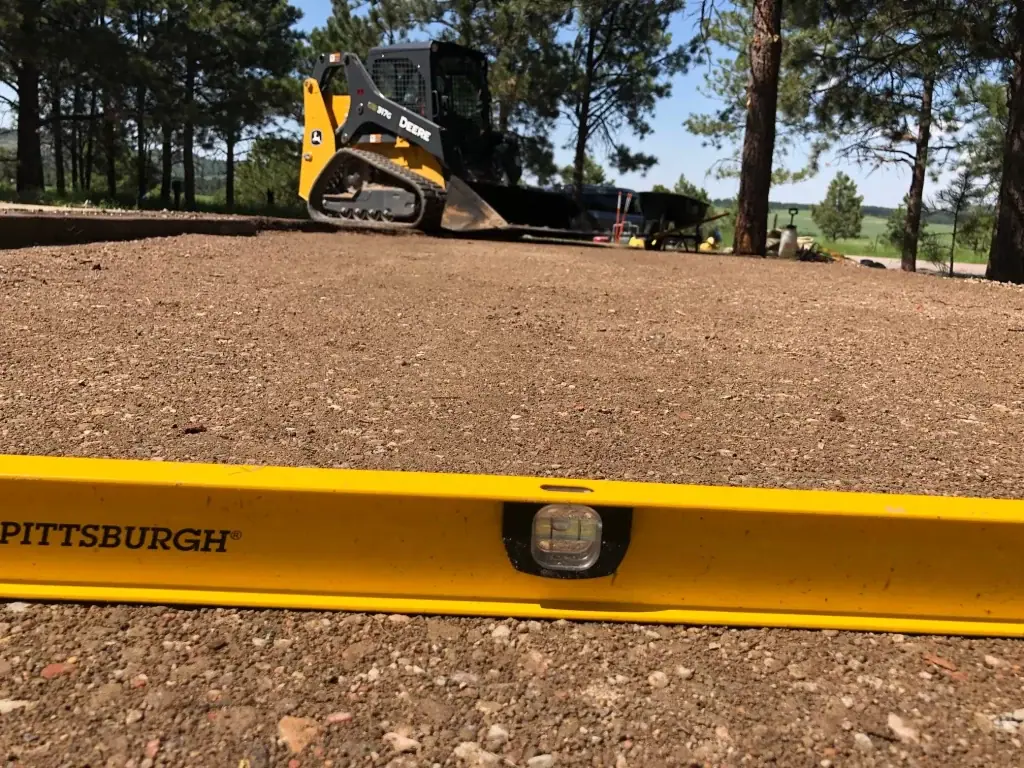
New asphalt on a Palmer Lake driveway usually goes down as about 3.5 to 4 inches of compacted mix in two lifts over a fresh stone base. Parking lots get more. A common driveway build is roughly 2 inches of base mix under 1.5 inches of surface mix, on 6 to 8 inches of compacted crushed aggregate.
The exact numbers are set once the old pavement is out and the crew can see what is underneath. When Paul's Asphalt handles asphalt removal and replacement in Palmer Lake, the old layer comes off, the base is checked and rebuilt where needed, and the new section is sized for the traffic it will carry.
Palmer Lake sits at 7,139 feet in El Paso County, so cold weather shapes the work too.
New Asphalt Thickness on a Palmer Lake Property After the Old Pavement Comes Out
New asphalt on a Palmer Lake property is usually 3.5 to 4 inches thick after compaction for a driveway. Asphalt magazine describes three common driveway sections: 4 inches of compacted hot mix on a full-depth driveway, 3 inches of asphalt over 4 inches of aggregate subbase, and 2 inches of intermediate binder mix under 1.5 inches of surface course on an aggregate base.
Each figure is a finished thickness. Pavement thicknesses are given "in terms of the final, compacted thicknesses," so the inches on a quote should describe the mat after rolling.
The right figure for your home depends on soil and traffic, since thickness "depends on the subgrade conditions and traffic loads."
For hot mix on a driveway alone, see how thick hot mix asphalt should be for a residential driveway in Palmer Lake.
Is a 2-Inch Layer Enough for a Palmer Lake Driveway That Sees Only Cars?
A 2-inch layer is enough for a Palmer Lake driveway only in a narrow case: a small driveway on good subgrade. That is the situation where Asphalt magazine quotes a paving contractor using 2 inches of compacted surface mix.
After old asphalt comes out, the subgrade has to prove firm before a thin section makes sense. On most replacements, two lifts of 3.5 to 4 inches is the safer build.
Stone Base Depth Under New Asphalt in Palmer Lake
The stone base under new asphalt on a Palmer Lake driveway is typically 6 to 8 inches of compacted crushed aggregate. It sits on a subgrade that is free of topsoil and vegetation, well compacted and free of soft spots.
Commercial work goes deeper. Asphalt magazine notes that most engineers will specify 8 inches of dense-graded aggregate, and where soil is weak it can be under-cut by a foot and replaced with high quality aggregate.
Drainage matters just as much. Asphalt magazine calls it "one of the most important factors" and gives a crown slope of 1/4 inch per linear foot so water runs off. Palmer Lake lies on the Palmer Divide, which separates the Arkansas River drainage to the south from the Platte River drainage to the north.
Many lots here have slope and runoff to plan around. For more on soil, read what base preparation Palmer Lake soil needs before hot mix asphalt is placed.
What Turns Up Under Old Asphalt That Changes the Base Depth?
What turns up under old asphalt decides how much base work a Palmer Lake replacement needs. Soft spots have to be dug out and filled, topsoil or vegetation in the subgrade has to come out, and drainage problems need fixing before new stone goes down.
On long rural driveways around Black Forest and Larkspur, conditions can change along the run, so the base gets checked from the road to the house. Before any digging, Colorado 811 asks for notice and tells excavators to allow three full business days for utility locates.
Asphalt Lift Thickness and Why New Asphalt in Palmer Lake Goes Down in Layers
New asphalt in Palmer Lake is laid in lifts because each layer can only be so thick for the stone in the mix, and each must be compacted before the next goes on.
The Pikes Peak Region Asphalt Paving Specifications, dated March 31, 2026, cover public paving in El Paso County, Colorado Springs and Fountain. They set the minimum compacted lift at three times the nominal aggregate size and the maximum at six times. Each lift has to reach density before the next, and lifts over 4 inches need engineer approval. The spec governs agency work, not private driveways, but it is the regional reference crews in the Pikes Peak area work from.
| Mix grade | Nominal stone size | Minimum compacted lift | Maximum compacted lift |
|---|---|---|---|
| SF | No. 4 sieve | 0.75 in. | 1.5 in. |
| ST | 3/8 in. | 1.125 in. | 2.5 in. |
| SX | 1/2 in. | 1.5 in. | 3 in. |
| S | 3/4 in. | 2.25 in. | 3.5 in. (4 in. with approval) |
That is why a 4-inch section normally goes down as a coarser lower lift and a finer surface lift. Asphalt magazine calls density "the single most important construction factor" for durability: each 1 percent drop in density costs about 10 percent of pavement life.
How to read the thickness on a replacement quote:
- Check that the asphalt figure is a compacted thickness.
- Look for the number of lifts and the thickness of each one.
- Find the base depth and whether new stone is included.
- Confirm a tack coat between lifts.
- See how drainage and crown are handled.
Why Does a Palmer Lake Paving Crew Spray a Tack Coat Between Layers?
A Palmer Lake paving crew sprays a tack coat so the layers bond and work as one pavement. The regional specification requires tack between a new mat and existing asphalt, and between the courses of a multi-course pavement.
The tack is an emulsion diluted no more than 1:1, spread at 0.08 to 0.2 gallons per square yard on a clean surface, never a wet one. Joints in each new lift sit at least 6 inches from the joint below.
Asphalt Thickness for a Palmer Lake Parking Lot Compared With a Driveway
A Palmer Lake parking lot needs more asphalt, more base, or both, because it carries more vehicles and heavier ones. The regional specification treats parking lots as their own design class, separate from its low, moderate and high traffic road classes.
| Use after removal | Stone base | Compacted asphalt |
|---|---|---|
| Residential driveway | 6 to 8 in. | About 3.5 in. (2 in. base mix, 1.5 in. surface) |
| Light-duty parking lot | 6 in. | 3 in. (or 4.5 in. full depth on subgrade) |
| Heavy-duty parking lot | 3 in. | 6 in. (or 7.5 in. full depth on subgrade) |
Figures vary by source and by traffic.
- If your driveway in Woodmoor or Monument carries cars and the base checks out, then two lifts around 3.5 to 4 inches is the usual build.
- If a camper or delivery truck uses the driveway, then have Paul and his crew set the base and asphalt depth for that load.
- If you manage a commercial lot on Highway 105, then truck traffic decides between the light and heavy rows. We remove and repave commercial lots.
How Palmer Lake's Cold Weather Affects Placing New Asphalt
Palmer Lake's cold weather changes when and how new asphalt is placed more than it changes the inches. The regional specification does not allow mix on standing water, frozen subgrade, snow or ice, and paving below its temperature table requires an approved cold-weather plan.
Thicker courses tolerate a little more cold. A surface course 3 inches or thicker can go down at 45 F with unmodified binder, and a lower course 3 inches or thicker at 35 F. Modified binders need warmer conditions, up to 60 F for a thin surface lift. At 7,139 feet, these limits decide which days a replacement can be paved.
What Air Temperature Is Too Cold to Lay New Asphalt in Palmer Lake in Fall?
For a typical 1.5-inch surface lift with unmodified binder, anything below 50 F is too cold. The regional specification sets 50 F as the minimum for both surface and air temperature, with air measured in the shade. Lower lifts of the same thickness can go down at 40 F.
Paving season winds down in Palmer Lake in fall and openings are limited, so book a late season job early.
Why Hire Paul's Asphalt to Remove and Replace Asphalt on a Palmer Lake Property
Paul's Asphalt is a locally owned contractor based at 702 Highway 105 in Palmer Lake. We have served Palmer Lake and nearby communities for 10 years and hold an A+ BBB rating.
Getting thickness right on a replacement takes removal, base work and paving in one sequence, and our crew does all of it: demolition and removal, excavation, grading, gravel base, drainage, milling and hot mix paving.
Paul works on jobs himself. Customers give the company 4.8 stars across more than 20 Google reviews and mention fair prices and quick turnaround. One wrote, "Paul responded to my request the very next day and then the following day they paved our driveways." Another had "a difficult driveway to pave due to varying slope" and said Paul and his crew did a great job. Reviewers also note that we come back to fix issues after a job.
We work across El Paso County, including Gleneagle, Black Forest and Colorado Springs, and north into Larkspur. Consultations are free, and the phone line is answered 24 hours a day.
The Bottom Line
New asphalt on a Palmer Lake driveway is usually about 3.5 to 4 inches of compacted mix in two lifts, over 6 to 8 inches of crushed stone, and parking lots run thicker. The final section is set once the old asphalt is out and the base is checked. To have Paul and his crew look at your driveway, lot or private road, call Paul's Asphalt at (719) 232-1523.
Providing Asphalt Contractor Services to Palmer Lake and the Greater Colorado Springs Area
Request a Quote