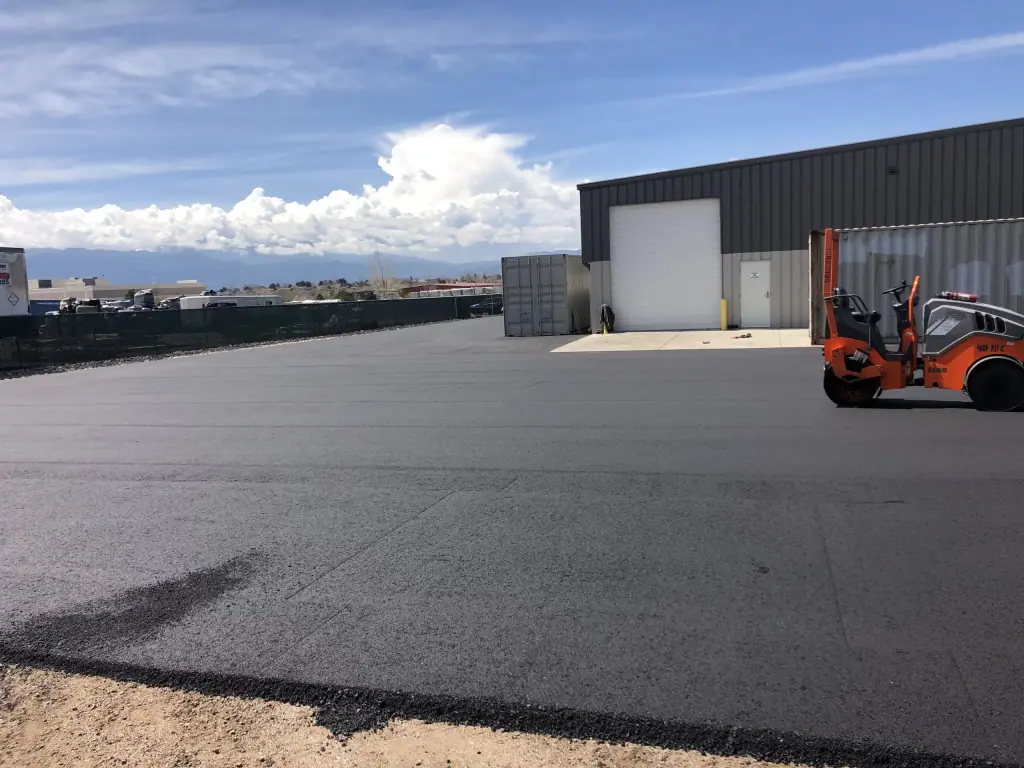
Industrial asphalt paving in Palmer Lake demands mixes and base work that handle heavy loads and Colorado freeze-thaw cycles. This page covers industrial asphalt paving in Palmer Lake for truck yards, equipment pads, access roads, and loading zones. Working with a licensed asphalt contractor means proper compaction, code compliance, and surfaces that hold up under industrial traffic. Industrial work is one part of our full range of parking lot paving in Palmer Lake CO, and the same crews that handle new asphalt parking lot paving build your yard or pad to spec.
How to Tell Your Industrial Surface Needs New Asphalt
Palmer Lake facility managers and fleet yard operators can spot pavement failure early by knowing what to look for. Catch it early and you’re patching cracks. Wait too long and you’re rebuilding base under heavy equipment, which costs a lot more.
Watch for these warning signs:
- Alligator cracking across tire paths
- Rutting or depressions under repeated wheel loads
- Soft spots that appear after rain
- Edge crumbling near drainage areas
Palmer Lake sits above 7,000 feet. That elevation matters. Freeze-thaw cycles up here break down pavement faster than at lower-elevation sites, so letting inspections slide means you’re usually looking at bigger repairs come spring. For the cracks and soft spots that show up between bigger projects, we also offer ongoing parking lot repair and maintenance to keep small problems from spreading.
Choosing the Right Industrial Asphalt Mix for Heavy-Load Sites
Industrial asphalt contractors select mix grades based on the actual loads a Palmer Lake site will carry, whether that means truck traffic, forklifts, or heavy machinery. The right mix resists rutting under point loads and fuel spills common to industrial surfaces.
Heavy-duty mixes use larger aggregate and higher asphalt content than standard parking lot paving. High-altitude UV exposure in the Tri-Lakes area breaks down lighter binders faster than at lower elevations. Mix selection carries more weight here than it does on a standard commercial job.
Base Preparation and Grading Before Industrial Paving in Palmer Lake
A compacted aggregate base is the single biggest factor in how long an industrial surface holds up under load. Owners of industrial lots in Palmer Lake with poor native soil need base work matched to actual site conditions.
The base preparation process includes:
- Subgrade inspection for bearing capacity
- Geotextile fabric installation where soil conditions require it
- Compacted base course placement
- Proof-roll testing before any asphalt is laid
Rocky mountain soil in Palmer Lake can have variable bearing capacity across a single parcel. Base thickness has to reflect what the soil at your specific site can actually support, not what worked on the lot next door. And if your operation is growing, we can pair base work with asphalt parking lot expansion to add capacity on the same site.
The Industrial Paving Process: What Happens on Your Palmer Lake Site
A licensed industrial asphalt contractor follows a defined sequence on industrial paving projects so Palmer Lake facility managers can plan equipment staging and reduce downtime. Knowing each step helps you prepare your site before the crew arrives.
The paving process moves in this order:
- Milling of old surface or tack coat application on existing pavement
- Hot-mix delivery and laydown by paving machine
- Steel drum rolling in passes for density
- Compaction checks to confirm spec is met
Asphalt plants serving Palmer Lake deliver hot-mix within haul windows that account for mix temperature requirements. Job scheduling at high-altitude sites factors in mountain road transit time so mix arrives at the right temperature for proper compaction. Once the surface is down, we can add parking lot striping and ADA parking lot compliance markings for truck lanes and accessible spaces, plus asphalt speed bump installation to control traffic through busy yards.
Inspecting Industrial Asphalt After Paving Is Complete
A post-paving walkthrough by the Palmer Lake facility owner or property manager catches compaction voids, low spots, or edge issues before heavy traffic loads the new surface. Complete this inspection before any equipment returns to the paved area.
Check the finished surface for uniform texture across the full paved area, proper drainage slope away from structures, smooth transitions at curbs and equipment aprons, and no visible roller marks or ridges.
Colorado afternoon rainstorms can reveal drainage problems within hours of paving completion. Walk the pad after the first rain event to confirm water moves off the way the grade intended.
Keeping Industrial Asphalt in Good Shape Long-Term in Palmer Lake
Industrial site operators in Palmer Lake who schedule regular maintenance protect their pavement investment and delay full replacement. Crack sealing and surface treatment done on schedule cost a fraction of what a full tearout and rebuild runs.
What that looks like in practice: annual crack sealing to stop water intrusion, periodic seal coat on lower-traffic zones, and pothole patching after each winter season. When the surface wears but the base still holds, parking lot resurfacing restores it at lower cost than a full rebuild. Palmer Lake winters open cracks fast. Spring is the best window for preventive sealing because the pavement has stabilized after winter and cracks are fully visible before summer traffic picks back up.
Other commercial paving we handle in Palmer Lake
Truck yards and equipment pads are one part of the commercial work we take on across the Front Range. We also handle warehouse asphalt paving and loading dock paving for high-traffic freight sites, retail parking lot paving for shopping centers, and apartment complex parking lot paving for multi-family communities. For institutional lots, we take on church parking lot paving and school parking lot paving built for steady daily use.
Frequently Asked Questions
How thick should industrial asphalt be for heavy truck traffic in Palmer Lake?
Industrial asphalt paving for heavy truck traffic in Palmer Lake typically uses 4 to 6 inches of compacted hot-mix over a 6 to 12 inch compacted aggregate base. Soil bearing capacity and expected axle loads at your site determine where in that range you land. We size the spec to what’s actually under your pavement, not a generic number.
What time of year is best to pave an industrial lot in Palmer Lake CO?
Late spring through early fall, from May through September, gives the best paving conditions at Palmer Lake’s elevation. Ground temperatures need to be above 50 degrees Fahrenheit for hot-mix to compact correctly, in line with federal pavement guidance on hot-mix asphalt temperature requirements. Paving outside that window at this altitude risks poor compaction and early surface failure, so we plan schedules accordingly.
Can an existing gravel yard in Palmer Lake be converted to industrial asphalt?
A gravel yard in Palmer Lake can be converted to industrial asphalt with the right base preparation. Conversion requires grading, base compaction, and sometimes subgrade stabilization before asphalt goes down. Rural parcels out here vary enough that we need to walk the site before we can tell you exactly what the conversion involves.
How long does it take to pave an industrial truck yard or equipment pad in Palmer Lake?
Project length for an industrial truck yard or equipment pad in Palmer Lake depends on square footage, the amount of base work needed, and haul distance from the asphalt plant. Larger sites with significant base work take longer than smaller, well-prepared pads.
Does industrial asphalt paving in Palmer Lake require a permit?
El Paso County and the Town of Palmer Lake may require grading or impervious-surface permits for large industrial paving projects. Permit requirements vary based on project size and site location. We sort out which permits apply before work starts so nothing holds up your project mid-job.
How soon can heavy equipment use a newly paved industrial surface in Palmer Lake?
Newly paved industrial asphalt in Palmer Lake needs 24 to 72 hours to cool and cure before light vehicle traffic can use the surface. Heavy equipment and loaded trucks should typically wait 5 to 7 days after paving is complete. In warm summer temperatures, plan for the longer end of that range before you put full loads on the surface.